Xiaofei Yu and Jinyan TianThis email address is being protected from spambots. You need JavaScript enabled to view it.
Dept Basic Courses, Henan Polytechnic Institute, Nanyang, 473000, China
Received: August 19, 2025 Accepted: October 27, 2025 Publication Date: December 27, 2025
Copyright The Author(s). This is an open access article distributed under the terms of the Creative Commons Attribution License (CC BY 4.0), which permits unrestricted use, distribution, and reproduction in any medium, provided the original author and source are cited.
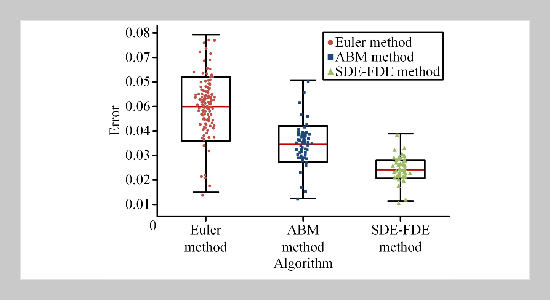
In response to the increasingly random and historical dependence challenges in the spread of infectious diseases, a new dynamic model has been proposed in this study. This model integrates stochastic differential equations and fractional differential equations. Stochastic differential equation terms capture random disturbances caused by environmental fluctuations and emergencies. Fractional differential equation terms precisely characterize long-range memory effects and non-local characteristics during propagation. Numerical simulation verified the advantages of the fusion model in terms of accuracy, stability and computational efficiency. In the comparative verification with the age stratified model and the delay differential model, the average error in a strongly disturbed environment decreased to 0.026 . The running time shortened to 0.45 s , and the convergence rate increased by up to 32.7%. When the basic reproduction number was 2.5 , the prediction accuracy rate reached 92.5±2.1%, precisely matching public health intervention practices. Experiments demonstrate that the SDE-FDE model more effectively captures the complex, dynamic characteristics of infectious diseases. It can simulate transmission trends in multiple scenarios and provide a theoretical basis for precise public health intervention strategies.
Keywords: Stochastic differential equations; Fractional order differential equations; Infectious disease models; Stochastic perturbations; Optimal control
[1] U. B. Odionyenma, N. Ikenna, and B. Bolaji, (2023) “Analysis of a model to control the co-dynamics of Chlamydia and Gonorrhea using Caputo fractional derivative" Mathematical Modelling and Numerical Simulation with Applications 3(2): 111–140.
[2] X. Qian and S. V. Ukkusuri, (2021) “Connecting urban transportation systems with the spread of infectious diseases: A Trans-SEIR modeling approach" Transportation Research Part B: Methodological 145: 185–211. DOI: 10.1016/j.trb.2020.12.012.
[3] F. Cao, X. Lü, Y. X. Zhou, and X. Y. Cheng, (2023) “Modified SEIAR infectious disease model for Omicron variants spread dynamics" Nonlinear Dynamics 111(15): 14597–14620. DOI: 10.1007/s11071-023-08578-6.
[4] D. Vinsensia, S. Amri, J. Sihotang, and H. T. Sihotang, (2024) “NewMethodforIdentification and Response to Infectious Disease Patterns Based on Comprehensive Health Service Data" MATRIK: Jurnal Manajemen, Teknik Informatika dan Rekayasa Komputer 23(3): 583–592.
[5] Y. Li, X. Mao, Q. Song, F. Wu, and G. Yin, (2023) “Strong convergence of Euler-Maruyama schemes for McKean-Vlasov stochastic differential equations under local Lipschitz conditions of state variables" IMA Journal of Numerical Analysis 43(2): 1001–1035. DOI: 10.1093/imanum/drac046.
[6] L. Yang, T. Gao, Y. Lu, J. Duan, and T. Liu, (2023) “Neural network stochastic differential equation models with applications to financial data forecasting" Applied Mathematical Modelling 115: 279–299. DOI: 10.1016/j.apm.2022.10.028.
[7] A.Qazza,M.Abdoon,R.Saadeh,andM.Berir,(2023) “Anewschemeforsolving a fractional differential equation and a chaotic system" European Journal of Pure and Applied Mathematics 16(2): 1128–1139.
[8] T.JinandH.Xia,(2023)“Lookbackoptionpricingmodels based on the uncertain fractional-order differential equation with Caputo type" Journal of Ambient Intelligence and Humanized Computing 14(6): 6435–6448. DOI: 10.1007/s12652-022-04271-2.
[9] S. Arshad, I. Siddique, F. Nawaz, A. Shaheen, and H. Khurshid, (2023) “Dynamics of a fractional order mathematical model for COVID-19 epidemic transmission" Physica A: Statistical Mechanics and its Applications 609: 128383. DOI: 10.1016/j.physa.2022.128383.
[10] R.Nawaz,N.M.A.NikLong,andS.Shohaimi,(2024) “Caputo Fractional Differential Equations for Low-risk Individuals of the Tuberculosis Transmission Disease" Malaysia Journal of Mathematical Sciences 18(4): 919–947.
[11] M. B. Jeelani, K. Shah, H. Alrabaiah, and A. S. Al nahdi, (2023) “On a SEIR-type model of COVID-19 using piecewise and stochastic differential operators undertaking management strategies" AIMS Mathematics 8(11): 27268–27290. DOI: 10.3934/math.20231389.
[12] N. H. Sweilam, S. M. Al-Mekhlafi, W. S. A. Kareem, and G. Alqurishi, (2025) “A new crossover dynamics mathematical model of monkeypox disease based on fractional differential equations and the-Caputo derivative: numerical treatments" Alexandria Engineering Journal 111(1): 181–193. DOI: 10.1016/j.aej.2024.11.020.
[13] Y. Guo, M. Chen, X. B. Shu, and F. Xu, (2021) “The existence and Hyers-Ulam stability of solution for almost periodical fractional stochastic differential equation with fBm" Stochastic Analysis and Applications 39(4): 643–666. DOI: 10.1080/07362994.2020.1845193.
[14] D. Huang, Y. Li, S. Guan, X. Zhang, and M. Tang, (2023) “A novel collaborative diagnosis approach of incipient faults based on VMD and SCN for rolling bearing" Optimal Control Applications and Methods 44(3): 1617–1631. DOI: 10.1002/oca.3161.
[15] M. Zhao, F. Bao, C. Li, and J. Zhu. “Egsde: Un paired image-to-image translation via energy-guided stochastic differential equations”. In: Advances in Neural Information Processing Systems. 35. 2022, 3609–3623.
[16] R. Sevinik Adigüzel, Ü. Aksoy, E. Karapinar, and ˙ I. M. Erhan, (2024) “On the solution of a boundary value problem associated with a fractional differential equation" Mathematical Methods in the Applied Sciences 47(13): 10928–10939. DOI: 10.1002/mma.9634.
[17] X. Chen, J. Li, C. Xiao, and P. Yang, (2021) “Numerical solution and parameter estimation for uncertain SIR model with application to COVID-19" Fuzzy Optimization and Decision Making 20(2): 189–208. DOI: 10.1007/s10700-020-09364-4.
[18] Y. C. Chen, P. E. Lu, C. S. Chang, and T. H. Liu, (2020) “A time-dependent SIR model for COVID-19 with undetectable infected persons" IEEE Transactions on Net work Science and Engineering 7(4): 3279–3294. DOI: 10.1109/TNSE.2020.3024723.
[19] R. Huang, M. Liu, and Y. Ding, (2020) “Spatial temporal distribution of COVID-19 in China and its pre diction: A data-driven modeling analysis" The Journal of Infection in Developing Countries 14(3): 246–253. DOI: 10.3855/jidc.12490.
[20] H. Khan, J. Alzabut, and H. Gulzar, (2023) “Existence of solutions for hybrid modified ABC-fractional differential equations with p-Laplacian operator and an application to a waterborne disease model" Alexandria Engineering Journal 70(14): 665–672. DOI: 10.1016/j.aej.2023.06.019.
[21] F. Evirgen, E. Uçar, S. Uçar, and N. Özdemir, (2023) “Modelling influenza a disease dynamics under Caputo Fabrizio fractional derivative with distinct contact rates" Mathematical Modelling and Numerical Simulation with Applications 3(1): 58–73.
[22] O. E. Santangelo, V. Gentile, S. Pizzo, D. Giordano, and F. Cedrone, (2023) “Machine learning and prediction of infectious diseases: a systematic review" Machine Learning and Knowledge Extraction 5(1): 175–198. DOI: 10.3390/make5010010.
[23] S. Ijeh, C. A. Okolo, J. O. Arowoogun, A. O. Adeniyi, and O. Omotayo, (2024) “Predictive modeling for dis ease outbreaks: a review of data sources and accuracy" International Medical Science Research Journal 4(4): 406–419.
We use cookies on this website to personalize content to improve your user experience and analyze our traffic. By using this site you agree to its use of cookies.