Rui TangThis email address is being protected from spambots. You need JavaScript enabled to view it.
Changchun University of Science and Technology Military Sports Department, Chang Chun, Ji Lin, 130022, China
Received: August 29, 2025 Accepted: October 26, 2025 Publication Date: January 10, 2026
Copyright The Author(s). This is an open access article distributed under the terms of the Creative Commons Attribution License (CC BY 4.0), which permits unrestricted use, distribution, and reproduction in any medium, provided the original author and source are cited.
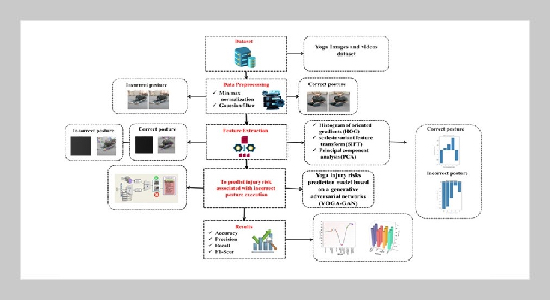
Incorrect execution of yoga postures, especially in unsupervised environments, increases the risk of musculoskeletal injuries. To address this challenge, a Yoga Injury Risk Prediction Model based on a Generative Adversarial Network (GAN) is proposed, named YOGA-GAN. This model aims to predict injury risks associated with incorrect posture execution. YOGA-GAN leverages the generative capabilities of GANs to create synthetic samples of rare or injury-prone yoga postures, enriching the dataset and mitigating class imbalance issues. The dataset consists of annotated images of both correct and incorrect poses. Preprocessing techniques, such as normalization and Gaussian filtering, are applied to enhance data quality. Feature extraction methods like Histogram of Oriented Gradients (HOG) and Scale-Invariant Feature Transform (SIFT) capture critical structural and textural features of each pose. Principal Component Analysis (PCA) is used for dimensionality reduction while retaining essential information. The discriminator in the GAN is adapted to serve a dual role: distinguishing between real and synthetic poses and predicting the injury risk level of each posture. The system is implemented using Python, providing a robust foundation for developing real-time yoga assistance systems aimed at reducing injury risks. Experimental evaluation demonstrates significant improvements in standard performance metrics, achieving accuracy ( 96.4% ), precision ( 97.1% ), recall ( 98.2% ), and F1-score ( 97.3% ) compared to traditional deep learning models. The YOGA-GAN framework presents a step forward in safer yoga practice and injury prevention.
[1] R. Barua. “Harmonizing Body and Mind: Investigating the Combined Impact of Yoga and Mindful ness Meditation on Depression, Anxiety, Stress”. In: Global Innovations in Physical Education and Health. IGI Global, 2025, 203–232. DOI: https: //doi.org/10.4018/979-8-3693-3952-7.ch008.
[2] M. Pundir, V. S. Yadav, A. R. Roj, S. Kumar, and R. Sharma, (2025) “Yoga Therapy: A Holistic Approach to Enhancing Physical, Psychological, and Social Health" Indian Journal of YOGA Exercise & Sport Science and Physical Education: 18–30. DOI: https: //doi.org/10.58914/ijyesspe.2025-10.1.4.
[3] G. Q. Liu, J. Y. Han, W. J. Song, and Y. Wang, (2022) “Research Progress of Yoga in Symptom Management of Cancer Patients" TMR Non-Drug Ther apy 5(2): 10. DOI: https: //doi.org/10.53388/TMRND20220531010.
[4] R. Bucea-Manea-T , onis , and D. G. P˘aun, (2024) “Yoga, a Mindfulness Therapy to Prevent PTSD as to Encompass Athletes’ Performance" Frontiers in Psychology 15: 1334278. DOI: https: //doi.org/10.3389/fpsyg.2024.1334278.
[5] G.WeiandL.Yi, (2025) “Predicting the Impact of Yoga on Chronic Venous Insufficiency: A Machine Learning Approach Using Naive Bayes Classifier and Optimization Systems" Journal of Ambient Intelligence and Humanized Computing: 1–23. DOI: https: //doi.org/10.1007/s12652-024-04889-6.
[6] X. Du,(2024) “Forecasting the Yoga Influence on Chronic Venous Insufficiency: Employing Machine Learning Methods" International Journal of Advanced Computer Science & Applications 15(3): DOI: https://doi.org/10.14569/ijacsa.2024.0150345.
[7] X.HanandN.Hu,(2024)“PredictionofOne-andThree Months Yoga Practices Effect on Chronic Venous Insufficiency Based on Machine Learning Classifiers" Egyptian Informatics Journal 27: 100507. DOI: https: //doi.org/10.1016/j.eij.2024.100507.
[8] J. Palanimeera and K. Ponmozhi, (2024) “Yoga Posture Recognition by Learning Spatial-Temporal Feature with Deep Learning Techniques" International Journal of Image and Graphics 24(06): 2450055. DOI: https: //doi.org/10.1142/S0219467824500554.
[9] D. Swain, S. Satapathy, B. Acharya, M. Shukla, V. C. Gerogiannis, A. Kanavos, and D. Giakovis, (2022) “Deep Learning Models for Yoga Pose Monitoring" Algorithms 15(11): 403. DOI: https: //doi.org/10.3390/a15110403.
[10] R. Pal, D. Adhikari, M. B. B. Heyat, I. Ullah, and Z. You, (2023) “Yoga Meets Intelligent Internet of Things: Recent Challenges and Future Directions" Bioengineering 10(4): 459. DOI: https: //doi.org/10.3390/bioengineering10040459.
[11] J. Liu and Y. Li, (2024) “Yoga Training Injury Detection Method Based on Multi-Sensor Information Fusion" Internet Technology Letters 7(5): e435. DOI: https: //doi.org/10.1002/itl2.435.
[13] D. M. Kishore, S. Bindu, and N. K. Manjunath, (2022) “Estimation of Yoga Postures Using Machine Learning Techniques" International Journal of Yoga 15(2): 137 143. DOI: https: //doi.org/10.4103/ijoy.ijoy_97_22.
[14] D. Mane, G. Upadhye, V. Gite, G. Sarwade, G. Kamble, and A. Pawar, (2023) “Smart Yoga Assistant: SVM Based Real-Time Pose Detection and Correction System" International Journal on Recent and Innovation Trends in Computing and Communication 11(7): 251–262. DOI: https: //doi.org/10.17762/ijritcc.v11i7s.6997.
[15] D. Borthakur, A. Paul, D. Kapil, and M. J. Saikia, (2023) “Yoga Pose Estimation Using Angle-Based Feature Extraction" Healthcare 11(24): 3133. DOI: https: //doi.org/10.3390/healthcare11243133.
[16] D. Parashar, O. Mishra, K. Sharma, and A. Kukker, (2023) “Improved Yoga Pose Detection Using Media Pipe and Move Net in a Deep Learning Model" Revue d’ Intelligence Artificielle 37(5): DOI: https://doi. org/10.18280/ria.370511.
[17] V. Anand Thoutam, A. Srivastava, T. Badal, V. Ku mar Mishra, G. R. Sinha, A. Sakalle, H. Bhardwaj, and M. Raj, (2022) “Yoga Pose Estimation and Feedback Generation Using Deep Learning" Computational Intelligence and Neuroscience 2022(1): 4311350. DOI: https://doi.org/10.1155/2022/4311350.
[18] A. Rawat, A. Balasundaram, and C. A. Vaithilingam, (2025) “Angle-Based Regularized Deep Learning Model for Gauging Effectiveness in Performing Yoga Postures" Sport Sciences for Health: 1–17. DOI: https: //doi.org/10.1007/s11332-025-01328-7.
[19] S. Yenishettil, G. Karajkhede, and L. Panat. “Virtual Yoga Teacher with AI Model for Yoga Posture Cor rection for Good Health”. In: 2024 ITU Kaleidoscope: Innovation and Digital Transformation for a Sustainable World (ITU K). IEEE, 2024, 1–8. DOI: https: //doi.org/10.23919/ITUK62727.2024.10772930.
[20] S. Mishra, I. Bhardwaj, A. Singh, T. Chakraborty, and A. Tripathi. “Real-Time Pose Correction and Wellness Tracking System for Enhanced Yoga Practice”. In: Challenges in Information, Communication and Computing Technology. CRC Press, 2025, 383–388. DOI: http: //dx.doi.org/10.1201/9781003559092-66.
[21] R. Bansal, R. Sharma, P. Jain, R. Arora, and S. Pal, (2024) “Deep Yoga: Enhancing Practice with a Real-Time Yoga Pose Recognition System" Engineering, Technology &Applied Science Research 14(6): 17704–17710. DOI: https: //doi.org/10.48084/etasr.8643.
[23] H. Jubair, R. T. Chowdhury, F. Akter, I. S. Sami, N. Nawal, S. T. Arshi, and P. Shil, (2025) “Machine Learning for Real-Time Exercise Correction and Injury Prevention: A Systematic Review" Machine Learning 13: 1.
[24] D. K. Reddy Basani, R. Lakshmi Gudivaka, S. H. Grandhi, B. Ramanjaneyulu Gudivaka, R. K. Gu divaka, and M. M. Kamruzzaman. “AI-Powered Motion Analysis in Physical Education: GANs and Bayesian Approaches”. In: 2025 4th OPJU International Technology Conference (OTCON) on Smart Computing for Innovation and Advancement in Industry 5.0. Raigarh, India: IEEE, 2025, 1–6. DOI: https: //doi.org/10.1109/OTCON65728.2025.11071118.
[25] A. Wang, X. Wu, L. Zhao, H. Chen, and S. Zhao, (2021) “Physical Activity Recognition from Accelerometer Data Using Multi-View Aggregation" Journal of Applied Science and Engineering 24(4): 30 April 2021. DOI: https: //doi.org/10.18280/jase.240416.
[26] A. Jha. “Leveraging OpenCV for Precise Yoga Pose Estimation and Reducing Injury Risks". Doctoral dissertation. (phdthesis). Dublin: National College of Ireland, 2025.
[27] E. Bagga and A. Yang. “Real-Time Posture Monitoring and Risk Assessment for Manual Lifting Tasks Using Media Pipe and LSTM”. In: Proceedings of the 1st International Workshop on Multimedia Computing for Health and Medicine. IEEE, 2024, 79–85. DOI: https: //doi.org/10.1145/3688868.3689199.
We use cookies on this website to personalize content to improve your user experience and analyze our traffic. By using this site you agree to its use of cookies.