Xiaoli QuThis email address is being protected from spambots. You need JavaScript enabled to view it.
Zhengzhou Technical College, No. 081, Zhengshang Road, Zhengzhou City, China
Received: January 21, 2026 Accepted: March 9, 2026 Publication Date: March 27, 2026
Copyright The Author(s). This is an open access article distributed under the terms of the Creative Commons Attribution License (CC BY 4.0), which permits unrestricted use, distribution, and reproduction in any medium, provided the original author and source are cited.
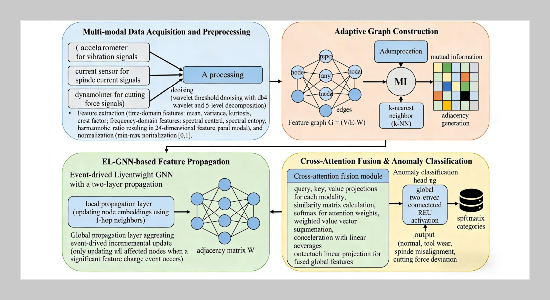
To address the limitations of single-modal data and low real-time performance in traditional anomaly diagnosis for CNC turning processes, this paper proposes a novel framework integrating adaptive multi-modal data fusion and lightweight graph neural network (GNN) for real-time anomaly diagnosis. First, multi-modal data (vibration, spindle current, and cutting force) are collected and preprocessed to extract time-frequency domain features. A mutual information-based graph construction method is designed to model the intrinsic correlations between multi-modal features, converting non-Euclidean feature data into structured graph data. Then, an event-driven lightweight GNN (EL-GNN) is proposed, which adopts a hierarchical propagation mechanism to reduce redundant computations and realizes millisecond-level inference. A cross-attention fusion module is embedded in the GNN to dynamically assign weights to different modal features, enhancing the robustness to noise. Experiments are conducted on a self-built CNC turning test platform and the public tool wear dataset. Results show that the proposed framework achieves an anomaly diagnosis accuracy of 98.73%, a recall rate of 98.51%, and a P99 inference latency of 28.3 ms , outperforming traditional machine learning methods and deep learning models by 3.2%−8.9% in accuracy. This framework provides a reliable solution for intelligent predictive maintenance in CNC turning processes, balancing diagnostic accuracy and real-time performance.
Keywords: Deep Learning-Driven; Adaptive Machining; Parameter Optimization; High-Precision CNC Milling
[1] P. Kailomsom, P. Nasawat, W. Khunthirat, and W. Phuangpornpitak, (2025) “A hybrid method based on BWM and TOPSIS-LP model to assess computer numerical control machines" Engineering Access 11(1): 108 118. DOI: 10.14456/mijet.2025.9.
[2] I. E. Oiye, P. Poojar, E. Qian, J. T. Vaughan Jr, and S. Geethanath, (2025) “A standalone and cost-effective MR-compatible computer numerical control machine for simultaneous, multi-parameter mapping" Measurement Science and Technology 36(4): 045902. DOI: 10.1088/1361-6501/adbb09.
[3] Z. A. Aldeeb and A. M. Hwas, (2025) “Design and Implementation of Computer Numerical Controlled Milling Machine for Printed Circuit Board Fabrication" African Journal of Advanced Pure and Applied Sciences 4(3): 116–125. DOI: 10.65418/ajapas.v4i3.1343.
[4] J. Singh, A. Singh, H. Singh, and P. Doyon-Poulin, (2025) “Implementation and evaluation of a smart ma chine monitoring system under industry 4.0 concept" Journal of Industrial Information Integration 43: 100746. DOI: 10.1016/j.jii.2024.100746.
[5] S. Yin, H. Li, A. A. Laghari, L. Teng, T. R. Gadekallu, and A. Almadhor, (2024) “FLSN-MVO: edge computing and privacy protection based on federated learning Siamese network with multi-verse optimization algorithm for industry 5.0" IEEE Open Journal of the Communications Society 6: 3443–3458. DOI: 10.1109/OJCOMS.2024.3520562.
[6] J. Sun, D. Wang, Z. Liu, C. Qiu, H. Liu, G. Sa, and J. Tan, (2025) “Tool digital twin based on knowledge embedding for precision CNC machine tools: Wear prediction for collaborative multi-tool" Journal of Manufacturing Systems 80: 157–175. DOI: 10.1016/j.jmsy.2025.02.021.
[7] A. D. Yewle, L. Mirzayeva, and O. Karaku¸s, (2025) “Multi-modal data fusion and deep ensemble learning for accurate crop yield prediction" Remote Sensing Applications: Society and Environment 38: 101613. DOI: 10.1016/j.rsase.2025.101613.
[8] X. WuandA.He,(2025) “Multimodal information fusion and artificial intelligence approaches for sustainable computing in data centers" Pattern Recognition Letters 189: 17–22. DOI: 10.1016/j.patrec.2024.12.006.
[9] Z. Gao, Y. Wang, X. Li, and J. Yao, (2024) “Twins trans former: rolling bearing fault diagnosis based on cross attention fusion of time and frequency domain features" Measurement Science and Technology35(9): 096113. DOI: 10.1088/1361-6501/ad53f1.
[10] J. Yu, L. Zhao, S. Yin, and M. Ivanovi´c, (2024) “News recommendation model based on encoder graph neural net work and bat optimization in online social multimedia art education" Computer Science and Information Systems 21(3): 989–1012. DOI: 10.2298/CSIS231225025Y.
[11] J. Wu, C. Ni, H. Wang, and J. Chen, (2025) “Graph neural networks for efficient clock tree synthesis optimization in complex SoC designs" Applied and Computational Engineering 150: 101–111. DOI: 10.54254/2755 2721/2025.22281.
[12] J. Dai, Z. Zhang, Z. Liu, and W. Yuan, (2025) “Im proved Detection of Mixed Pesticide Solution Concentrations Using Deep Learning with Segmented Stride 1D CNN and Color Rendering Index Features" Journal of the ASABE68(3): 353–363. DOI: 10.13031/ja.16122.
[13] J.Choi,Z.Xiong,andK.Kang,(2025)“Longshort-term memory-based computerized numerical control machining center failure prediction model" Mathematics 13(7): 1093. DOI: 10.3390/math13071093.
[14] M. Ahmadzadeh, S. M. Zahrai, and M. Bitaraf, (2025) “An integrated deep neural network model combining 1D CNN and LSTM for structural health monitoring utilizing multi sensor time-series data" Structural Health Monitoring 24(1): 447–465. DOI: 10.1177/14759217241239041.
[15] R. Li, H. Shen, Q. Zhang, and H. Duan, (2025) “An edge-enhanced graph SAGE-based intrusion detection model for the internet of things" Cluster Computing 28(5): 309. DOI: 10.1007/s10586-025-05100-x.
[16] D. Wu, Z. Li, and T. Mitra.“Ink stream: Instantaneous GNN Inference on Dynamic Graphs via Incremental Update”. In: 2025 IEEE International Parallel and Distributed Processing Symposium (IPDPS). IEEE. 2025, 1273–1285. DOI: 10.1109/IPDPS64566.2025.00115.
[17] L.Teng,H.Li,andY.Si,(2025)“NeuralTensor Network And Adaptive Graph Convolution For Sports" Journal of Applied Science and Engineering 29(6): 1483–1491. DOI: 10.6180/jase.202606_29(6).0015.
We use cookies on this website to personalize content to improve your user experience and analyze our traffic. By using this site you agree to its use of cookies.