Ying Wen and Tao FengThis email address is being protected from spambots. You need JavaScript enabled to view it.
Department of Physical Education and Sports Teaching, Harbin Finance University, Harbin,150000, China
Received: March 4, 2026 Accepted: March 27, 2026 Publication Date: April 18, 2026
Copyright The Author(s). This is an open access article distributed under the terms of the Creative Commons Attribution License (CC BY 4.0), which permits unrestricted use, distribution, and reproduction in any medium, provided the original author and source are cited.
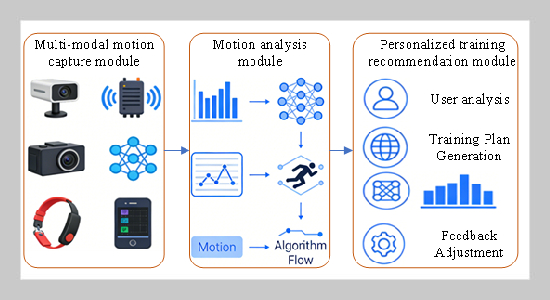
With the increasing emphasis on physical and mental health, aerobics and yoga have become two of the most popular forms of physical activity worldwide. However, traditional training methods rely heavily on professional instructors, which are limited by high costs, uneven teaching quality, and lack of real-time feedback. To address these issues, this study proposes a comprehensive framework for computer-based motion analysis and personalized training recommendation, integrating computer vision, deep learning, and biomechanical principles to achieve accurate motion evaluation and adaptive training guidance. First, a multi-modal motion capture system is designed to collect 2D/3D human skeleton data and surface electromyography (EMG) signals during aerobics and yoga exercises. Second, a novel cascade two-stream adaptive graph convolutional neural network (Cascade 2S-AGCN) is proposed for motion feature extraction and error recognition, which outperforms existing methods in terms of recognition accuracy and real-time performance. Third, a personalized training recommendation model based on reinforcement learning (RL) is established, considering user physical characteristics, training goals, and motion performance to generate adaptive training plans. Extensive experiments are conducted on a self-built multi-view aerobics and yoga dataset (MAY-Dataset) and public datasets (3D-Yoga, M3GYM), involving 80 participants with different fitness levels. The experimental results show that the proposed motion analysis model achieves an average recognition accuracy of 96.87% for aerobics movements and 97.53% for yoga poses, with a motion error detection rate of 95.21%. The personalized recommendation model significantly improves user training adherence (by 32.4%) and training effect (by 28.7%) compared with traditional uniform training plans. This study provides a scientific and intelligent solution for aerobics and yoga training, promotes the digital transformation of fitness services, and lays a foundation for the development of intelligent fitness systems.
Keywords: Computer-based motion analysis; Aerobics and Yoga; Personalized training recommendation; Deep learning; Biomechanics
[1] N. Shinde, K. Shinde, S. Khatri, and D. Hande, (2013) “A comparative study of yoga and aerobic exercises in obesity and its effect on pulmonary function" J diabetes metab 4(257): 2. DOI: 10.4172/2155-6156.1000257.
[2] R. A. Rain, T. Bhattacharjee, P. Patel, P. s. Rajbhar, V. Aesha, and N. Suratiya, (2026) “Premenstrual Syn drome: Exploring the Role of Current Understanding of Lifestyle Factors and Future Research Prospects" Journal of Psychosexual Health: 26318318261420868. DOI: 10.1177/26318318261420868.
[3] S. Maisaroh and W. Wisudawati, (2026) “Efektivitas Senam Hamilterhadap Penurunan Tingkat Nyeri Persalinan, Systematic Literature Review" Journal of Midwifery Practice and Professionalism 1(1): 1–12. DOI: 10.56861/jmpp.v1i1.23.
[4] H.-S. Yoo. “Integrative approaches to constipation and diarrhea”. In: Comprehensive Integrative Oncology. Elsevier, 2026, 321–329. DOI: 10.1016/B978-0-443-30194-0.00017-5.
[5] J. Berhouet and R. Samargandi, (2024) “Emerging innovations in preoperative planning and motion analysis in orthopedic surgery" Diagnostics 14(13): 1321. DOI: 10.3390/diagnostics14131321.
[6] J.-W. Kim, J.-Y. Choi, E.-J. Ha, and J.-H. Choi, (2023) “Human pose estimation using mediapipe pose and optimization method based on a humanoid model" Applied sciences 13(4): 2700. DOI: 10.3390/app13042700.
[7] Y. Qiu, Y. Guan, and S. Liu, (2023) “The analysis of infrared high-speed motion capture system on motion aesthetics of aerobics athletes under biomechanics analysis" Plos one 18(5): e0286313. DOI: 10.1371/journal.pone.0286313.
[8] L. Teng, H. Li, and Y. Si, “Neural Tensor Network And Adaptive Graph Convolution For Sports" Journal of Applied Science and Engineering 29(6): 1483–1491. DOI: 10.6180/jase.202606_29(6).0015.
[9] P.Yang.“Kinematics Analysis of Aerobics Movement Decomposition Based on Multi-Target Video Tracking Algorithm”. In: International conference on Big Data Analytics for Cyber-Physical-Systems. Springer. 2021, 21–28. DOI: 10.1007/978-981-16-7466-2_3.
[10] Z. Xian, E. Yang, W. Pan, and Z. Ming, (2026) “Fed HoG: Federated Homogeneous Graph Neural Network for Privacy-Preserving Recommendation" ACM Transactions on Information Systems 44(3): DOI: 10.1145/ 3787468.
[11] P. Nilsen, K. Thomas, H. Augustsson Öfverström, M. Fagerström, K. Hald, and J. W. Kirk, “The the ory behind the strategies: interpreting the Expert Recommendations for Implementing Change (ERIC) taxonomy through four behavioural lenses" Frontiers in Health Services 6: 1800608. DOI: https://www.frontiersin. org/journals/health-services/articles/10.3389/ frhs.2026.1800608/abstract.
[12] Y. Yang and Y. Zhao, (2025) “Personalized sports health recommendation system assisted by Q-learning algorithm" International Journal of Human–Computer Interaction 41(4): 1889–1901. DOI: 10.1080/10447318.2023.2295693.
[13] J.ChenandY.Wang,(2025)“Personalizedfitness recommendations using machine learning for optimized national health strategy" Scientific Reports 15(1): 41652. DOI: 10.1038/s41598-025-25566-4.
[14] Y. Wu, Q. Lin, M. Yang, J. Liu, J. Tian, D. Kapil, and L. Vanderbloemen. “A computer vision-based yoga pose grading approach using contrastive skeleton feature representations”. In: 10. 1. MDPI. 2021, 36. DOI: 10.3390/healthcare10010036.
[15] P. Lin, G. Shi, C. Hu, J. Zhang, and Y. Huang, (2026) “Auto-arrange buildings in urban planning with DQN" Scientific Reports: DOI: 10.1038/s41598-026-40788-w.
[16] J. Li, H. Hu, J. Li, and X. Zhao. “3D-Yoga: a 3D yoga dataset for visual-based hierarchical sports action analysis”. In: Proceedings of the Asian Conference on Computer Vision. 2022, 434–450. DOI: 10.1007/978-3-031-26319-4_4.
[17] Q. Xu, R. Cao, X. Shen, H. Du, S. Wang, and X. Yu. “M3GYM: A Large-Scale Multimodal Multi-view Multi-person Pose Dataset for Fitness Activity Understanding in Real-world Settings”. In: Proceedings of the Computer Vision and Pattern Recognition Confer ence. 2025, 12289–12300. DOI: 10.1109/CVPR52734. 2025.01147.
[18] J. Wu, L. Wang, G. Chong, and H. Feng. “2S-AGCN human behavior recognition based on new partition strategy”. In: 2022 Asia-Pacific Signal and Information Processing Association Annual Summit and Conference (APSIPA ASC). IEEE. 2022, 157–163. DOI: 10.23919/ APSIPAASC55919.2022.9980273.
[19] F. Liu, N. Zhao, and G. Zhu, (2025) “Cognitive differ ence text classification in online knowledge collaboration based on SA-BiLSTM hybrid model" Scientific Reports 15(1): 22171. DOI: 10.1038/s41598-025-06914-w.
[20] L. mawaddah Wisudawati and A. M. S. Alhadar, (2026) “Deteksi Bahasa Isyarat SIBI Secara Real Time Menggunakan Mediapipe Holistic dan LSTM" Jurnal Teknologi Informasidan Ilmu Komputer 13(1): 47 56. DOI: 10.25126/jtiik.2026131.
We use cookies on this website to personalize content to improve your user experience and analyze our traffic. By using this site you agree to its use of cookies.