Xiaowei NieThis email address is being protected from spambots. You need JavaScript enabled to view it.
Shenyang City University, Shenyang City, 110000 China
Received: December 28, 2025 Accepted: January 24, 2026 Publication Date: February 14, 2026
Copyright The Author(s). This is an open access article distributed under the terms of the Creative Commons Attribution License (CC BY 4.0), which permits unrestricted use, distribution, and reproduction in any medium, provided the original author and source are cited.
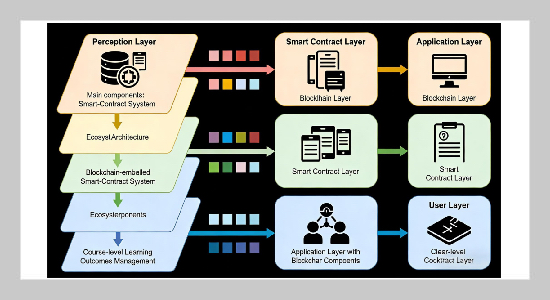
Real-time monitoring and dynamic optimization of course-level learning outcomes (CLOs) are crucial for improving the quality of higher education, yet traditional evaluation systems face challenges such as data centralization, poor real-time performance, lack of trustworthiness, and inefficient feedback loops. To address these issues, this study proposes a blockchain-enabled smart-contract ecosystem for CLOs management. First, we design a multi-layered ecosystem architecture, including the perception layer, blockchain layer, smart contract layer, application layer, and user layer, to realize full-process automation and trustworthiness of CLOs management. Second, we formalize the CLOs evaluation index system and design a dynamic weight calculation model based on analytic hierarchy process (AHP) and entropy weight method, which is encapsulated into smart contracts to realize real-time and objective evaluation of learning outcomes. Third, we propose a feedback-driven dynamic improvement mechanism, where smart contracts automatically trigger targeted teaching adjustment suggestions based on real-time evaluation results. The proposed ecosystem is implemented on the Ethereum blockchain, and experiments are conducted with 3 undergraduate courses from two universities involving 523 students. Objective experimental results show that the ecosystem achieves a data transmission delay of 0.8-1.2 seconds, a data tamper-proof rate of 100%, and an evaluation accuracy of 92.3% compared with manual evaluation. Subjective evaluation results from teachers and students indicate that the ecosystem significantly improves the timeliness of teaching feedback (89.7% positive evaluation) and the effectiveness of learning outcome improvement ( 86.3% positive evaluation). This study provides a new technical solution for real-time and trusted management of CLOs, and contributes to the digital transformation of higher education evaluation.
[1] M. Zainuba, O. C. Kutlubay, A. Rahal, and R. Stone, (2025) “Measuring learning outcomes in cross-cultural relations courses: the case for experiential learning" Journal of International Education in Business 18(1): 47–64. DOI: 10.1108/JIEB-12-2023-0098.
[2] E. A. Alawad, A. Mujumdar, and A. Ali, (2025) “Pedagogical Determinants of Variability in Course Learning Outcome Attainment in Academic Writing: A Case Study" Journal of Cultural Analysis and Social Change: 2842–2852. DOI: 10.64753/jcasc.v10i2.2021.
[3] S. Yin, L. Wang, T. Chen, H. Huang, J. Gao, J. Zhang, M. Liu, P. Li, and C. Xu, (2025) “LKAFormer: A Lightweight Kolmogorov-Arnold Transformer Model for Image Semantic Segmentation" ACM Transactions on Intelligent Systems and Technology: DOI: 10.1145/ 3759254.
[4] A. Forsyth; (2025) “Daring to Stop: Challenging Program-Level Learning Outcome Measurement in Urban Planning Accreditation" Journal of Plan ning Education and Research: DOI: 10.1177/0739456X251314198.
[5] A.F. Schwegler, M. D. Shell, and D. A. Clark, (2025) “UsingGuidelines 3.0 to support program and course learning outcome alignment." Scholarship of Teaching and Learning in Psychology 11(1): 65. DOI: 10.1037/stl0000414.
[6] R. Salm, E. Bate, and A. R. Leslie, (2025) “Standardization and Alignment of Student Learning Outcomes for Sociology Courses in Maryland Public Colleges" Teaching and Learning Excellence through Scholarship 5(1): DOI: 10.52938/tales.v5i1.3486.
[7] S. Aminah, A. A. Krisnadhi, and A. N. Hidayanto, (2025) “Ontological Framework for the Analysis of Outcome-Based Curriculum in Higher Education" IEEE Access 13: 31497–31516. DOI: 10.1109/ACCESS.2025.3542881.
[8] A. R. Ekasara, A. R. B. Nugroho, S. Pambudi, and M. P. Muttahari. “Developing A Learning Outcomes Assessment Model for Geological Engineering Edu cation Based on OBE and CQI Framework”. In: RSF Conference Series: Business, Management and Social Sci ences. 5. 2. Research Synergy Foundation. 2025, 173. DOI: 10.31098/bmss.v5i2.964.
[9] J. Yu, L. Zhao, S. Yin, and M. Ivanovi´c, (2024) “News recommendation model based on encoder graph neural net work and bat optimization in online social multimedia art education" Computer Science and Information Sys tems 21(3): 989–1012. DOI: 10.2298/CSIS231225025Y.
[10] A. M. Prasetyawati, W. Saragih, M. Frima, and A. Romadhony. “Analyzing of the Alignment between Course Learning Outcomes (CLOs) and Program Learning Outcomes (PLOs) Using Textual Similarity Based Methods”. In: 2025 International Conference on Advancement in Data Science, E-learning and Information System (ICADEIS). IEEE. 2025, 1–6. DOI: 10.1109/ICADEIS65852.2025.10933307.
[11] D. Frost and R. Ackrill, (2025) “The multiple dimensions of curriculum mapping: designing a comprehensive outcomes-based framework" London Review of Education 23(1): 17. DOI: 10.14324/LRE.23.1.17.
[12] M. N. Abd Ghani and I. F. Nusyirwan, (2025) “Be yond Grades-Predicting Programme Learning Outcomes with Multi-Output Regression in Malaysian Higher Edu cation: Melangkaui Gred: Meramal Hasil Pembelajaran Program (PLO) dengan Regresi Pelbagai Hasildalam Pendidikan Tinggi Malaysia" Sains Insani 10(2): 124–138. DOI: 10.33102/sainsinsani.vol10no2.838.
[13] Y. Lu, S. Yeom, R. Ryu, and S.-H. Kim, (2025) “Course Level Clustering to Enhance Dropout Prediction Accu racy" IEEE Access 13: 204996–205013. DOI: 10.1109/ ACCESS.2025.3639083.
[14] M. AlShaikh-Hasan and G. Ghinea. “Predicting Student Performance Using Deep Learning and Machine Learning Techniques”. In: 2025 1st International Conference on Computational Intelligence Approaches and Applications (ICCIAA). IEEE. 2025, 1–6. DOI: 10.1109/ICCIAA65327.2025.11013240.
[16] E. Papageorgiou, J. Wong, Q. Liu, M. Khalil, and A. J. Cabo, (2025) “A Systematic Review on Student Engagement in Undergraduate Mathematics: Conceptualization, Measurement, and Learning Outcomes" Educational Psychology Review 37(3): 66. DOI: 10.1007/s10648 025-10046-y.
We use cookies on this website to personalize content to improve your user experience and analyze our traffic. By using this site you agree to its use of cookies.