Karim R. GubashiThis email address is being protected from spambots. You need JavaScript enabled to view it., Saad Mulahasan, and Haider Ali Al-Mussawy
Department of Water Resources Engineering, College of Engineering, Mustansiriyah University, Baghdad, 10047, Iraq.
Received: October 14, 2025 Accepted: January 3, 2026 Publication Date: February 14, 2026
Copyright The Author(s). This is an open access article distributed under the terms of the Creative Commons Attribution License (CC BY 4.0), which permits unrestricted use, distribution, and reproduction in any medium, provided the original author and source are cited.
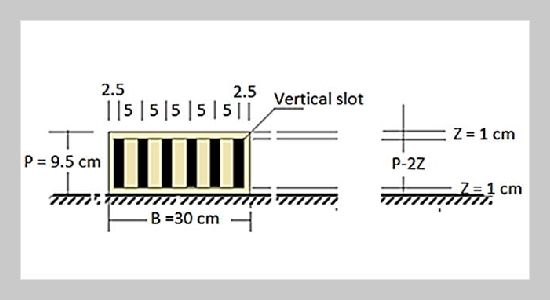
In this study an experimental work was conducted to characterize the hydraulic properties of flow through a wall containing rectangular vertical openings under both partially and fully submerged conditions. Laboratory tests were carried out at the hydraulics and hydrology laboratory at Mustansiriyah University in a tilting recirculating flume with controlled opening configurations and flow rates. Dimensional analysis was performed to derive the governing parameters, and in contrast, empirical correlations were determined through regression analysis. It was found that the discharge coefficients are highly dependent on submergence, head loss ratio, and Froude number. For partially submergence, the discharge coefficient for partially submerged outlets increases with flow and Froude number, while for fully submerged outlets, discharge coefficients decrease with increasing discharge, but positively with Froude number. The head loss was dependent on the flow discharge and showed a direct proportion which confirms the importance of dissipation of energy effects. With strong coefficients of determination, the empirical equations that are produced are accurate and dependable for hydrological design predictive analysis. The improvement of rivers, sluice gates, spillways, and drainage systems is made possible by these studies, which also help to clarify the flow patterns through rectangular apertures.
Keywords: orifice flow, fully and partially submerged outlet, discharge coefficient, experiments, head loss.
[1] I. M. MohamedandF.S. Abdelhaleem, (2020) “Flow downstream sluice gate with orifice" KSCE Journal of Civil Engineering 24(12): 3692–3702. DOI: 10.1007/s12205-020-0441-3.
[2] C.Rapp. “Outflow from openings”. In: Hydraulics in Civil Engineering. Springer Nature Switzerland, 2024, 123–135. DOI: 10.1007/978-3-031-54860-4_9.
[3] W.H.Hager. Energy dissipators and hydraulic jump. 8. Springer Science & Business Media, 2013. DOI: 10.1007/978-94-015-8048-9.
[4] A. Yildiz, A. Yarar, M. A. Hinis, and G. E. Yarbasi Kayhanlar, (2023) “Experimental and numerical investigation of flow patterns in symmetrical spurs" Journal of Computational Applied Mechanics 54(3): 425–436. DOI: 10.22059/jcamech.2023.364744.869.
[5] A.Tomaszewski, T. Przybylinski, and M. Lackowski, (2020) “Experimental and numerical analysis of multi hole orifice flow meter: investigation of the relationship be tween pressure drop and mass flow rate" Sensors 20(24): 7281. DOI: 10.3390/s20247281.
[6] M. Mehraein, M. Torabi, Y. Sangsefidi, and B. MacVicar, (2020) “Numerical simulation of free flow through side orifice in a circular open-channel using response surface method" Flow Measurement and Instrumentation 76: 101825. DOI: 10.1016/j.flowmeasinst.2020.101825.
[7] N.Y. Saad and E. M. Fattouh, (2017) “Hydraulic characteristics of flow over weirs with circular openings" Ain Shams Engineering Journal 8(4): 515–522. DOI: 10.1016/j.asej.2016.05.007.
[8] S. Mulahasan and A. Mohammed, (2021) “Hydraulic characteristics of flow-through bridge openings" Appl Eng Lett 6(1): 21–28. DOI: 10.18485/aeletters.2021.6.1.3.
[9] W. Cheng, Y. Shen, and G. Xu, (2020) “Experimental and numerical modeling of sidewall orifices" SN Applied Sciences 2(5): 873. DOI: 10.1007/s42452-020-2658-7.
[10] M. Zeinivand, M. Ghomeshi, et al., (2024) “The dis charge coefficient of sharp triangular weir pierced by orifices" Flow Measurement and Instrumentation 97: 102560. DOI: 10.1016/j.flowmeasinst.2024.102560.
[11] B. Das, Z. Ahmad, and P. K. Sharma, (2024) “Dis charge characteristics of lateral rectangular orifice intakes in open channel flow" Arabian Journal of Geosciences 17(1): 4. DOI: 10.1007/s12517-023-11816-0.
[12] A. Hussain and A. Haroon, (2021) “Numerical analysis for free flow through side rectangular orifice in an open channel" ISH Journal of Hydraulic Engineering 27(sup1): 314–321. DOI: 10.1080/09715010.2019.1648220.
[13] R. H. Irzooki, S. M. Akib, and M. M. Fayyadh, (2014) “Experimental study of characteristics of flow over weirs with semicircular openings" Arabian Journal for Science and Engineering 39(11): 7599–7608. DOI: 10. 1007/s13369-014-1360-8.
[14] R. M. Qasim and A. S. Dawood, (2023) “Hydraulic Behavior of Weir-Gate Structure with Rectangular Side Obstacle under Free and Submerged Flow Conditions." Instrumentation, Mesures, Métrologies 22(6): DOI: 10.18280/i2m.220604.
[15] H. Al-Naely, Z. Al-Khafaji, and S. Khassaf, (2018) “Effect of opening holes on the hydraulic performance for crump weir" International Journal of Engineering 31(12): 2022–2027. DOI: 10.5829/ije.2018.31.12c.05.
[16] B. S. Hussein and S. A. Jalil, (2020) “Hydraulic performance for combined weir-gate structure" Tikrit Journal of Engineering Sciences 27(1): 40–50. DOI: 10.25130/tjes.27.1.06.
[17] W.Zhang,X.Jia,andY.Wang,(2024)“Experimental Investigation of Hydraulic Characteristics for Open Channel Gates" Water 16(24): 3717. DOI: 10.3390/w16243717.
[18] Q.Yang, Y. Sun, X. Wang, W. Lu, and X. Wang, (2011) “Effects of turbulence models on the numerical simulation of flow in open channel junction" Mechanics of Ad vanced Materials and Structures 18(8): 566–571. DOI: 10.1080/15376494.2011.621800.
[19] S. Mulahasan, F. M. Al-Mohammed, and A.-S. T. Al Madhhachi, (2021) “Effect of blockage ratio on flow characteristics in obstructed open channels" Innovative Infrastructure Solutions 6(4): 211. DOI: 10.1007/s41062 021-00592-z.
[20] S. Mulahasan, F. M. Al-Mohammed, N. Rajaa, K. R. Gubashi, et al., (2025) “Hydraulic Conditions Created by Passing Flow Through and Over a Combined Weir" Civil Engineering Journal 11(05): DOI: 10.28991/CEJ-2025 011-05-016.
[21] K. R. Gubashi, S. Mulahasan, Z. A. Hacheem, A. Q. Rdhaiwi, et al., (2024) “Effect of the stepped spillway geometry on the flow energy dissipation" Civil Engineering Journal 10(1): 79–92. DOI: 10.28991/CEJ-2024 010-01-09.
[22] A. Shariq, A. Hussain, and Z. Ahmad, (2020) “Dis charge equation for the gabion weir under through flow condition" Flow Measurement and Instrumentation 74: 101769. DOI: 10.1016/j.flowmeasinst.2020.101769.
We use cookies on this website to personalize content to improve your user experience and analyze our traffic. By using this site you agree to its use of cookies.