Phuc Phan Van, Long Tran NgocThis email address is being protected from spambots. You need JavaScript enabled to view it., Khanh Nguyen Duy, Hung Nguyen Manh, Tuan Nguyen Trong, and Thai Tran Anh
Department of Civil Engineering, Vinh University, Vinh 461010, Vietnam
Received: September 29, 2025 Accepted: January 18, 2026 Publication Date: February 14, 2026
Copyright The Author(s). This is an open access article distributed under the terms of the Creative Commons Attribution License (CC BY 4.0), which permits unrestricted use, distribution, and reproduction in any medium, provided the original author and source are cited.
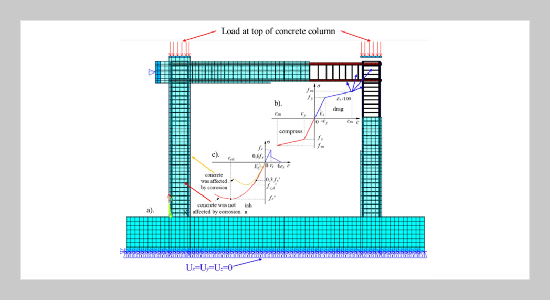
The corrosion of steel reinforcement poses a significant threat to the safety and longevity of reinforced concrete (RC) structures by inducing a potential shift from ductile to brittle failure. This study presents a comprehensive 3Dnonlinear finite element model (FEM) to systematically quantify this transition in single-story, single-bay RC frames. The model, validated against experimental data with high accuracy (<7.5% deviation), incorporates key degradation mechanisms, including rebar section loss, material property deterioration, and critically, bond-slip interface degradation. Acknowledging the idealization of uniform corrosion and monotonic loading to establish a fundamental capacity envelope, an extensive parametric study (230 simulations) was conducted. Results identified the axial compression ratio as the most detrimental parameter, causing up to a 56.7% reduction in lateral capacity, while column reinforcement was the most effective strengthening parameter, enhancing capacity by 39%. A key finding is the heightened vulnerability of higher-strength concrete to corrosion-induced capacity loss, attributed to its brittle nature exacerbating bond degradation. The primary contribution of this research is the development of a "Failure Mode Map," a novel graphical tool that quantitatively delineates the transition from a safe "Ductile-Flexural" failure zone to a dangerous "Brittle-Bond" zone as a function of corrosion level and axial load. This map provides a practical framework for structural assessment, highlighting critical thresholds beyond which conventional capacity models are non-conservative and unsafe.
[1] D. Liu, C. Wang, J. Gonzalez-Libreros, T. Guo, J. Cao, Y. Tu, L. Elfgren, and G. Sas, (2023) “A Review of Concrete Properties under the Combined Effect of Fatigue and Corrosion from a Material Perspective" Construction and Building Materials 369: 130489. DOI: 10.1016/j.conbuildmat.2023.130489.
[2] J. Zhang, J. Yang, and T. Yu, (2025) “Durability of FRP Bars and FRP-Reinforced Concrete Beams: A Critical Review of Accelerated Aging Tests and Performance In sights" Composites Part B: Engineering 308: 112965. DOI: 10.1016/j.compositesb.2025.112965.
[3] B. Kordtabar and M. Dehestani, (2020) “Effect of Corrosion in Reinforced Concrete Frame Components on Pushover Behavior and Ductility of Frame" Computers and Concrete 25(4): 321–333. DOI: 10.12989/cac.2020.25.4.321.
[4] P. Mishra, P. K. Behera, and S. Misra, (2024) “3D Non linear Finite Element Simulation of RC Beams Corroding under Service Loads" Journal of Structural Integrity and Maintenance 9(2): 1–15. DOI: 10.1080/24705314.2023.2285514.
[5] K. Sorbari et al., (2024) “The Effect of Corrosion on the Mechanical Properties (Diameter, Cross-Sectional Area, Weight) of the Reinforcing Steel" Middle East Research Journal of Engineering and Technology 4(2): 39–53. DOI: 10.36348/merjet.2024.v06i02.003.
[6] Y.G.Du,L.A.Clark,andA.H.C.Chan,(2005)“Residual Capacity of Corroded Reinforcing Bars" Magazine of Concrete Research 57(3): 135–147. DOI: 10.1680/macr.2005.57.3.135.
[7] C. Andrade, C. Alonso, and F. J. Molina, (1993) “Cover Cracking as a Function of Bar Corrosion: Part I Experimental Test" Materials and Structures 26: 453 464. DOI: 10.1007/BF02472942.
[8] X. Hu, H. Xu, X. Xi, P. Zhang, and S. Yang, (2022) “Meso-Scale Phase Field Modelling of Reinforced Concrete Structures Subjected to Corrosion of Multiple Reinforcements" Construction and Building Materials 321: 126376. DOI: 10.1016/j.conbuildmat.2021.126376.
[9] H. Lee, T. Noguchi, and F. Tomosawa, (2002) “Evaluation of the Bond Properties between Concrete and Reinforcement as a Function of the Degree of Reinforcement Corrosion" Cement and Concrete Research 32(8): 1313–1318. DOI: 10.1016/S0008-8846(02)00783-4.
[10] K. Bhargava, A. K. Ghosh, Y. Mori, and S. Ramanu jam, (2008) “Suggested Empirical Models for Corrosion Induced Bond Degradation in Reinforced Concrete" Journal of Structural Engineering 134(2): 221–230. DOI: 10.1061/(ASCE)0733-9445(2008)134:2(221).
[11] H. Nasser, C. Van Steen, L. Vandewalle, and E. Verst rynge, (2021) “An Experimental Assessment of Corrosion Damage and Bending Capacity Reduction of Singly Reinforced Concrete Beams Subjected to Accelerated Corrosion" Construction and Building Materials 286: 122773. DOI: 10.1016/j.conbuildmat.2021.122773.
[12] W. Xie, J. Sheng, Z. Yu, Y. Li, and G. Dou, (2023) “Flexural Behavior of Corroded RC Beams Strengthened by Textile-Reinforced Concrete" Buildings 13(12): 2902. DOI: 10.3390/buildings13122902.
[13] T. Paulay and M. J. N. Priestley. Seismic Design of Reinforced Concrete and Masonry Buildings. 4th ed. John Wiley & Sons, Inc., 1992.
[14] Comité Euro-International du Béton. Seismic Design of Reinforced Concrete Structures for Controlled Inelastic Response: Design Concepts. Leeds, UK: Emerald Publishing Limited, 1998.
[15] D. Santos, J. Melo, A. Furtado, and H. Varum, (2024) “Numerical Study on Influence of Corrosion and Vertical Irregularities on Seismic Behaviour of RC Frame Structures" Buildings 14(1): 288. DOI: 10.3390/buildings14010288.
[16] W.-T. Lin, (2015) “Shaking Table Test for a Scale-Down Reinforced Concrete Structure Considering Corrosive De terioration" Journal of Vibro engineering 17(1): 137–145.
[17] M. E. Arslan and S. Pul, (2020) “Bond Behavior Investigation of Ordinary Concrete-Rebar with Hinged Beam Test and Eccentric Pull-Out Test" Computers and Concrete 26(6): 587–593. DOI: 10.12989/cac.2020.26.6.587.
[18] S. Dauji and K. Bhargava. “Estimation of Corrosion Induced Bond Strength Degradation in Concrete with Artificial Neural Networks”. In: Proceedings of International Corrosion Conference and Expo (CORCON 2016). 2016, Paper No. 27.
[19] L. Simwanda, A. B. David, O. B. Olalusi, I. B. Muhit, and M.Sykora, (2025) “Shear Capacity Prediction and Reliability Analysis of Corroded Reinforced Concrete Beams Using Deep Generative Modeling and Ensemble Learning" Engineering Applications of Artificial Intelligence 137: 109153. DOI: 10.1016/j.engappai.2024. 111085.
[20] D. Coronelli and P. Gambarova, (2004) “Structural Assessment of Corroded Reinforced Concrete Beams: Modeling and Validation" Journal of Structural Engineer ing 130(8): 1214–1224. DOI: 10.1061/(ASCE)0733 9445(2004)130:8(1214).
[21] S. Ahmad, (2014) “An Experimental Study on Correlation between Concrete Resistivity and Reinforcement Corrosion Rate" Anti-Corrosion Methods and Materials 61(3): 158–165. DOI: 10.1108/ACMM-11-2012-1219.
[22] X. Liu, H. Jiang, and L. He, (2017) “Experimental Investigation on Seismic Performance of Corroded Rein forced Concrete Moment-Resisting Frames" Engineering Structures 153: 639–652. DOI: 10.1016/j.engstruct.2017.10.050.
[23] J.J. Jensen, E. Thorenfeldt, and A. Tomaszewicz. “Mechanical Properties of High-Strength Concrete and Application in Design”. In: Proceedings of the Symposium on Utilization of High-Strength Concrete. Stavanger, Norway, 1987.
[24] S. Dauji, (2016) “Empirical Model for Evaluation of Concrete Corrosion Current Density" Concrete Research Letters 7(3): 104–112.
[25] L. Chung, J. J. Kim, and S. Yi, (2008) “Bond Strength Prediction for Reinforced Concrete Members with Highly Corroded Reinforcing Bars" Cement and Concrete Composites 30(7): 603–611. DOI: 10.1016/j.cemconcomp.2008.03.006.
[26] S. Dauji and K. Bhargava. “Estimation of Corrosion Induced Bond Strength Degradation in Concrete with Artificial Neural Networks”. In: Proceedings of International Corrosion Conference and Expo (CORCON 2016). Duplicate of Reference [18]. 2016, Paper No. 27.
[27] L. Chung, J. J. Kim, and S. Yi, (2008) “Bond Strength Prediction for Reinforced Concrete Members with Highly Corroded Reinforcing Bars" Cement and Concrete Composites 30(7): 603–611. DOI: 10.1016/j.cemconcomp.2008.03.006.
[28] fib-International Federation for Structural Concrete. fib Model Code for Concrete Structures 2010. Ernst & Sohn, 2013. DOI: 10.1002/9783433604090.
[29] T. El Maaddawy, K. Soudki, and T. Topper, (2005) “Analytical Model to Predict Nonlinear Flexural Behavior of Corroded Reinforced Concrete Beams" ACI Structural Journal 102(4): 550–559. DOI: 10.14359/14559.
[30] K. J. Elwood and J. P. Moehle, (2005) “Axial Capacity Model for Shear-Damaged Columns" ACI Structural Journal 102(4): 578–587. DOI: 10.14359/14562.
[31] P. Monteiro and P. Mehta. Concrete: Microstructure, Properties and Materials. 4th ed. McGraw-Hill Education, 2006.
[32] H. Krawinkler and G. D. P. K. Seneviratna, (1998) “Pros and Cons of a Pushover Analysis of Seismic Performance Evaluation" Engineering Structures 20(4-6): 452–464. DOI: 10.1016/S0141-0296(97)00029-3.
We use cookies on this website to personalize content to improve your user experience and analyze our traffic. By using this site you agree to its use of cookies.