Likang Qin1, Ying Dong2, and Zeyu Li3This email address is being protected from spambots. You need JavaScript enabled to view it.
1School of Economics and Management, Yan’an University, Yan’an 716000, ShaanXi, China
2School of Economics, Henan University, Kaifeng 475004, Henan, China
3Xi’an Electronic Engineering Research Institute, Xi’an 710100, ShaanXi, China
Received: January 3, 2026 Accepted: February 15, 2026 Publication Date: March 21, 2026
Copyright The Author(s). This is an open access article distributed under the terms of the Creative Commons Attribution License (CC BY 4.0), which permits unrestricted use, distribution, and reproduction in any medium, provided the original author and source are cited.
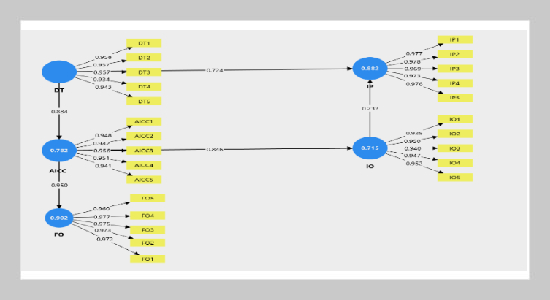
The corporate innovation landscape has dramatically transformed by the fast adoption of digital technologies, especially the likes of AI and cloud computing. The researchers opine that the study’s aim is to understand the impact of using both cloud computing and artificial intelligence (AI) in different organizational contexts on the innovation performance of the organizations. The use of Partial Least Squares Structural Equation Modelling enabled to analyse data obtained through quantitative cross-sectional survey administered to 530 individuals from different industries for the purpose of evaluating direct, indirect and moderating effects. The results indicate that digital transformation is a major factor in improving innovation outcomes, with the adoption of AI and cloud as the most effective drivers for increasing corporations’ innovations in terms of frequency, quality, and scalability. Factors like experience, role, and top management support of the organization also play a moderating role in these relationships. The research points out how important it is to have unified digital approaches in the accomplishment of sustainable innovation performance. Besides that, it gives a lot of valuable and significant insights both practically and theoretically for people engaged in or exploring the digital age. Partial Least Squares Structural Equation Modeling (PLS-SEM) was employed due to its ability to simultaneously estimate complex relationships involving direct, indirect, and moderating effects, making it particularly suitable for examining the interconnected roles of digital transformation, AI, and cloud computing in innovation performance.
[1] M. Alojail and S. B. Khan, (2023) “Impact of Digital Transformation toward Sustainable Development" Sustainability 15(20): 14697. DOI: 10.3390/su152014697.
[2] A. A. Várzaru and C. G. Bocean, (2024) “Digital Transformation and Innovation: The Influence of Digital Technologies on Turnover from Innovation Activities and Types of Innovation" Systems 12(9): 359. DOI: 10.3390/systems12090359.
[3] Q.HuangandY.Tang,(2025)“EnterpriseDigitalTrans formation Strategy: The Impact of Digital Platforms" Entropy 27(3): 295. DOI: 10.3390/e27030295.
[4] B. H. Leso, M. N. Cortimiglia, and A. Ghezzi, (2023) “The contribution of organizational culture, structure, and leadership factors in the digital transformation of SMEs: a mixed-methods approach" Cognition, Technology & Work 25(1): 151–179. DOI: 10.1007/s10111-022-00714-2.
[5] L.NingandD.Yao,(2023)“TheImpactofDigitalTrans formation on Supply Chain Capabilities and Supply Chain Competitive Performance" Sustainability 15(13): 10107. DOI: 10.3390/su151310107.
[6] R. MasoudandS. Basahel, (2023) “The Effects of Digital Transformation on Firm Performance: The Role of Customer Experience and IT Innovation" Digital 3(2): 109–126. DOI: 10.3390/digital3020008.
[7] M.Z. Yaqub and A. Alsabban, (2023) “Industry-4.0 Enabled Digital Transformation: Prospects, Instruments, Challenges, and Implications for Business Strategies" Sustainability 15(11): 8553. DOI: 10.3390/su15118553.
[8] V. M. M. Latilla, A. Urbinati, A. Cavallo, S. Franzò, and A. Ghezzi, (2021) “Organizational Re-Design for Business Model Innovation while Exploiting Digital Technologies: A Single Case Study of an Energy Company" International Journal of Innovation and Technology Management 18(2): 2040002. DOI: 10.1142/S0219877020400027.
[9] M. Atienza-Barba, M. C. del Río-Rama, Á. Meseguer Martínez, and V. Barba-Sánchez, (2024) “Artificial intelligence and organizational agility: An analysis of scientific production and future trends" European Re search on Management and Business Economics 30(2): 100253. DOI: 10.1016/j.iedeen.2024.100253.
[10] M. Slavkovi´c, K. Pavlovi´c, T. M. Nikoli´c, T. Vuˇcenovi´c, and M. Bugarˇci´c, (2023) “Impact of Digital Capabilities on Digital Transformation: The Mediating Role of Digital Citizenship" Systems 11(4): 172. DOI: 10.3390/systems11040172.
[11] D.Sharma,N.Reddy,P.Gupta,andR.Sharma,(2022) “Enhancing Customer Experience Personalization through AI: Leveraging Collaborative Filtering, Neural Networks, and Natural Language Processing" Journal of AI and ML Research 11(7): URL: https: //www.joaimlr.com/index.php/v1/article/view/32.
[12] S. Wu and Y. Li, (2023) “A Study on the Impact of Digital Transformation on Corporate ESG Performance: The Mediating Role of Green Innovation" Sustainability 15(8): 6568. DOI: 10.3390/su15086568.
[13] O.A.AlghamdiandG.Agag,(2023)“Boosting Innovation Performance through Big Data Analytics Powered by Artificial Intelligence Use: An Empirical Exploration of the Role of Strategic Agility and Market Turbulence" Sustainability 15(19): 14296. DOI: 10.3390/su151914296.
[14] F. Pascucci, E. Savelli, and G. Gistri, (2023) “How digital technologies reshape marketing: evidence from a qualitative investigation" Italian Journal of Marketing 2023(1): 27–58. DOI: 10.1007/s43039-023-00063-6.
[15] M. Grebe, M. R. Franke, and A. Heinzl, (2023) “Artificial intelligence: how leading companies define use cases, scale-up utilization, and realize value" Informatik Spektrum 46(4): 197–209. DOI: 10.1007/s00287-023-01548-6.
[16] X. Zhang, (2024) “Optimizing scientific workflow scheduling in cloud computing: a multi-level approach using whale optimization algorithm" Journal of Engineering and Applied Science 71(1): 175. DOI: 10.1186/s44147-024-00512-9.
[17] T. Pu, Y. Li, and A. H. Zulkafli, (2024) “Digital Trans formation and Corporate Innovation: Empirical Discovery Based on Machine Learning" Asian Academy of Management Journal of Accounting and Finance 20(2): 121–153. DOI: 10.21315/aamjaf2024.20.2.4.
[18] P. Chen and S. Kim, (2023) “The impact of digital trans formation on innovation performance- The mediating role of innovation factors" Heliyon 9(3): e13916. DOI: 10.1016/j.heliyon.2023.e13916.
[19] M. Xu, Y. Zhang, H. Sun, Y. Tang, and J. Li, (2024) “Howdigital transformation enhances corporate innovation performance: The mediating roles of big data capabilities and organizational agility" Heliyon 10(14): e34905. DOI: 10.1016/j.heliyon.2024.e34905.
[20] X. Zhu, (2025) “Hybrid Ant Colony and Whale Optimization algorithms for QoS-aware loading balancing in cloud computing environment" Journal of Engineering andAppliedScience72(1): 169. DOI: 10.1186/s44147 025-00739-0.
[21] S. Li, L. Gao, C. Han, B. Gupta, W. Alhalabi, and S. Almakdi, (2023) “Exploring the effect of digital transformation on Firms’ innovation performance" Journal of Innovation & Knowledge8(1): 100317. DOI: 10.1016/j.jik.2023.100317.
[22] S. M. Devaraj, (2024) “Cloud, AI, and Digital Transformation: A Winning Combination" International Journal of Computer Engineering and Technology 15(5): DOI: 10.5281/ZENODO.14008047.
[23] P. Jorzik, S. P. Klein, D. K. Kanbach, and S. Kraus, (2024) “AI-driven business model innovation: A systematic review and research agenda" Journal of Business Research 182: 114764. DOI: 10.1016/j.jbusres.2024.114764.
[24] J. Ma, Y. Shang, and Z. Liang, (2025) “Digital transformation, artificial intelligence and enterprise innovation performance" Finance Research Letters 78: 107190. DOI: 10.1016/j.frl.2025.107190.
[25] Z. Wang, S. Lin, Y. Chen, O. Lyulyov, and T. Pimo nenko, (2023) “Digitalization Effect on Business Performance: Role of Business Model Innovation" Sustainability 15(11): 9020. DOI: 10.3390/su15119020.
[26] M. Saeedikiya, S. Salunke, and M. Kowalkiewicz, (2025) “The nexus of digital transformation and innovation: A multilevel framework and research agenda" Journal of Innovation & Knowledge 10(1): 100640. DOI: 10.1016/j.jik.2024.100640.
[27] W.Basri, (2020) “Examining the Impact of Artificial In telligence (AI)-Assisted Social Media Marketing on the Performance of Small and Medium Enterprises" International Journal of Computational Intelligence Systems 13(1): 142–152. DOI: 10.2991/ijcis.d.200127.002.
[28] F. Gao, C. Lin, and H. Zhai, (2022) “Digital Transformation, Corporate Innovation, and International Strategy: Empirical Evidence from Listed Companies in China" Sustainability 14(13): 8137. DOI: 10.3390/su14138137.
[29] J. Díaz-Arancibia, J. Hochstetter-Diez, A. Bustamante Mora, S. Sepúlveda-Cuevas, I. Albayay, and J. Arango-López, (2024) “Navigating Digital Transformation and Technology Adoption: A Literature Review from SMEs in Developing Countries" Sustainability 16(14): 5946. DOI: 10.3390/su16145946.
[30] S. Kodadi, D. P. Deevi, N. S. Allur, K. Dondapati, and H. Chetlapalli, (2025) “AI-Driven Unified Channel Management in Cognitive Radio IoT Networks" Journal of IoT, Social, Mobile, Analytics and Cloud 6(4): 395–412. DOI: 10.36548/jismac.2024.4.007.
[31] F. J. Cantú-Ortiz, N. Galeano Sánchez, L. Garrido, H. Terashima-Marin, and R. F. Brena, (2020) “An artificial intelligence educational strategy for the digital transformation" International Journal of Interactive Design and Manufacturing 14(4): 1195–1209. DOI: 10.1007/s12008-020-00702-8.
[32] V. Ramírez-Herrero, M. Ortiz-de-Urbina-Criado, and J.-A. Medina-Merodio, (2024) “Intergenerational Lead ership: A Leadership Style Proposal for Managing Diversity and New Technologies" Systems 12(2): 50. DOI: 10.3390/systems12020050.
[33] J. Xu and W. Lu, (2022) “Developing a human organization-technology fit model for information technol ogy adoption in organizations" Technology in Society 70: 102010. DOI: 10.1016/j.techsoc.2022.102010.
[34] S.BadghishandY.A.Soomro,(2024)“Artificial Intelli gence Adoption by SMEs to Achieve Sustainable Business Performance: Application of TOE Framework" Sustain ability 16(5): 1864. DOI: 10.3390/su16051864.
[35] I. Oncioiu, D. A. Mândricel, and M. H. Hojda, (2025) “Artificial Intelligence-Enabled Digital Transformation in Circular Logistics: A Structural Equation Model" Logis tics 9(3): 102. DOI: 10.3390/logistics9030102.
We use cookies on this website to personalize content to improve your user experience and analyze our traffic. By using this site you agree to its use of cookies.