Hong-Son Nguyen1, Van-Quyen Nguyen2, Ngoc-An Tran3, Phan-Anh Nguyen3This email address is being protected from spambots. You need JavaScript enabled to view it., and Ngoc-Dung Bui4
1HaUI Institute of Technology, Hanoi University of Industry, Hanoi, Vietnam
2Department of Mechatronics, School of Mechanical Engineering, Hanoi University of Science and Technology, Hanoi, Vietnam
3Faculty of Civil Engineering, Vietnam Maritime University, Haiphong City, Vietnam
4Faculty of Technology and Engineering, Hai Phong University, Haiphong City, Vietnam
Received: July 29, 2025 Accepted: November 6, 2025 Publication Date: December 21, 2025
Copyright The Author(s). This is an open access article distributed under the terms of the Creative Commons Attribution License (CC BY 4.0), which permits unrestricted use, distribution, and reproduction in any medium, provided the original author and source are cited.
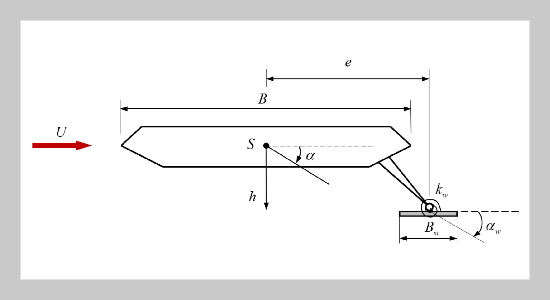
A wide range of studies have focused on improving the aerodynamic stability of long-span bridges by raising their critical flutter wind speed. There are two main approaches to enhancing aerodynamic stability: mechanical and aerodynamic methods. The aerodynamic approach suppresses vibrations not by dissipating energy, but by generating additional aerodynamic forces induced through the installation of thin plates. However, the optimization process in the case of passive control is highly complex, as it involves not only the forces generated by wind interaction with the deck structure but also those acting on attached thin plates. This paper proposes an optimization algorithm that simplifies the determination of optimal parameters for wings used in passive aerodynamic control. Based on the complex eigenvalue method, the optimization process is implemented using the Genetic Algorithm (GA) function available in MATLAB. In addition, this paper also reviews several previously proposed passive aerodynamic control strategies and, based on that, introduces a novel configuration: a wing mounted to one side of the deck using a hinged connection and a torsional spring. Numerical simulation results demonstrate that the newly proposed configuration outperforms previous approaches in all investigated scenarios.
[1] H.-L. BuiandN.-A.Tran,(2022)“Multi-objective optimal design of TMDs for increasing critical flutter wind speed of bridges "Journal of Wind Engineering and Industrial Aerodynamics 225:104992. DOI:10.1016/j.jweia.2022.104992.
[2] N. Van Khang, A. Seils, T. N. An, N. P. Dien, and N. T. Nghia,(2016)“An improvement of the step-by-step analysis method for study on passive flutter control of a bridge deck "Archive of Applied Mechanics 86:557–573.DOI:10.1007/s00419-015-1046-z.
[3] M.Gu,C.Chang,W.Wu,andH.Xiang,(1998)“In crease of critical flutter wind speed of long-span bridges using tuned mass dampers "Journal of Wind Engineering and Industrial Aerodynamics 73(2):111–123.DOI:10.1016/S0167-6105(97)00282-1.
[4] S.-D. Kwon and K.-S.Park, (2004)“Suppressionof bridge flutter using tuned mass dampers based on robust performance design "Journal of Wind Engineering and Industrial Aerodynamics 92(11):919–934. DOI: 10.1016/j.jweia.2004.05.006.
[5] F.Ubertini,(2010)“Prevention of suspension bridge flutter using multiple tuned mass dampers "Wind & structures13(3):235–256. DOI:10.12989/was.2010.13.3.235.
[6] F.Ubertini,G.Comanducci,andS.Laflamme,(2017) “Aparametric study on reliability-based tuned-mass damper design against bridge flutter "Journal of Vibration and Control23(9):1518–1534.DOI:10.1177/1077546315595304.
[7] S.Xue,J.Ko,andY.L.Xu,(2000)“Tunedliquidcolumn damper for suppressing pitching motion of structures " Engineering Structures 22(11):1538–1551.DOI:10. 1016/S0141-0296(99)00099-1.
[8] S.Xue,J.Ko,andY.L.Xu,(2000)“Optimum parameters of tuned liquid column damper for suppressing pitching vibration of anundamped structure "Journal of sound andvibration235(4):639–653.DOI:10.1006/jsvi.2000.2947.
[9] J.-C. Wu, Y.-P. Wang, C.-L. Lee, P.-H. Liao, and Y.-H. Chen, (2008) “Wind-induced interaction of a non uniform tuned liquid column damper and a structure in pitching motion" Engineering Structures 30(12): 3555–3565. DOI: 10.1016/j.engstruct.2008.05.029.
[10] D. C. d. Arco and Á. C. Aparicio, (1999) “Improving suspension bridge wind stability with aerodynamic appendages" Journal of Structural Engineering 125(12): 1367–1375. DOI: 10.1061/(ASCE)0733-9445(1999)125: 12(1367).
[11] P. Omenzetter, K. Wilde, and Y. Fujino, (2000) “Sup pression of wind-induced instabilities of a long span bridge by a passive deck–flaps control system: Part I: Formulation" Journal of Wind Engineering and Industrial Aerodynamics 87(1): 61–79. DOI: 10.1016/S0167-6105(00)00016-7.
[12] P. Omenzetter, K. Wilde, and Y. Fujino, (2000) “Sup pression of wind-induced instabilities of a long span bridge by a passive deck-flaps control system: Part II: Numerical simulations" Journal of Wind Engineering and Industrial Aerodynamics 87(1): 81–91. DOI: 10.1016/S0167-6105(00)00017-9.
[13] P. Omenzetter, K. Wilde, and Y. Fujino, (2002) “Study of passive deck-flaps flutter control system on full bridge model. I: theory" Journal of Engineering Mechanics 128(3): 264–279. DOI: 10.1061/(ASCE)0733-9399(2002) 128:3(264).
[14] P. Omenzetter, K. Wilde, and Y. Fujino, (2002) “Study of passive deck-flaps flutter control system on full bridge model. II: Results" Journal of engineering mechanics 128(3): 280–286. DOI: 10.1061/(ASCE)0733-9399(2002) 128:3(280).
[15] K. Wilde, Y. Fujino, and T. Kawakami, (1999) “Analytical and experimental study on passive aerodynamic control of flutter of a bridge deck" Journal of Wind Engineering and Industrial Aerodynamics 80(1-2): 105 119. DOI: 10.1016/S0167-6105(98)00196-2.
[16] T. N. An and N. V. Khang, (2015) “Increase of critical flutter wind speed of long-span bridges using passive separate control wings" 16th Asia Pacific Vibration Conference, Vietnam: 649–653.
[17] U. Starossek and H. Aslan. “Passive control of bridge deck flutter using tuned mass dampers and control surfaces”. In: 7th European Conference on Structural Dynamics, 7–9.
[18] U. Starossek, (2016) “Eccentric-wing flutter stabilizer for long-span bridges" Bridge structures 12(1-2): 3–9. DOI: 10.3233/BRS-160098.
[19] U. Starossek, T. Ferenczi, and J. Priebe, (2018) “Eccentric-wing flutter stabilizer for bridges–analysis, tests, design, and costs" Engineering structures 172: 1073–1080. DOI: 10.1016/j.engstruct.2018.06.056.
[20] U. Starossek and R. T. Starossek, (2021) “Parametric flutter analysis of bridges stabilized with eccentric wings" Journal of wind engineering and industrial aero dynamics 211: 104566. DOI: 10.1016/j.jweia.2021. 104566.
[21] U. Starossek and R. T. Starossek, (2021) “Flutter analysis methods for bridges stabilized with eccentric wings" Journal of wind engineering and industrial aero dynamics 219: 104804. DOI: 10.1016/j.jweia.2021.104804.
[22] S. Phongkumsing, K. Wilde, and Y. Fujino, (2001) “Analytical study on flutter suppression by eccentric mass method on FEM model of long-span suspension bridge" Journal of Wind Engineering and Industrial Aero dynamics 89(6): 515–534. DOI: 10.1016/S0167 6105(00)00077-5.
[23] D. J. Limebeer, J. M. R. Graham, and X. Zhao, (2011) “Buffet suppression in long-span suspension bridges" Annual Reviews in Control 35(2): 235–246. DOI: 10.1016/j.arcontrol.2011.10.012.
[24] E. Simiu and R. H. Scanlan. Wind effects on structures: fundamentals and applications to design. 688. John Wiley New York, 1996.
[25] C. Dyrbye and S. O. Hansen. Wind loads on structures. Wiley, 1996.
[26] H. Kobayashi and H. Nagaoka, (1992) “Active control of flutter of a suspension bridge" Journal of Wind Engineering and Industrial Aerodynamics 41(1-3): 143–151. DOI: 10.1016/0167-6105(92)90402-V.
[28] Y. Fung. An introduction to the theory of aeroelasticity. Courier Dover Publications, 2008.
[29] R. L. Bisplinghoff, H. Ashley, and R. L. Halfman. Aeroelasticity. Courier Corporation, 2013.
[30] U.Starossek. Brückendynamik: Winderregte Schwing ungen von Seilbrücken. Springer-Verlag, 2013.
[31] U. Starossek, H. Aslan, and L. Thiesemann, (2009) “Experimental and numerical identification of flutter derivatives for nine bridge deck sections" Wind and Structures 12(6): 519. DOI: 10.12989/was.2009.12.6.519.
[32] S. S. Rao. Engineering Optimization Theory and Practice 4th Edition. John Wiley & Sons, 2009.
[33] R. Fletcher. Practical methods of optimization. John Wi ley & Sons, 2000.
We use cookies on this website to personalize content to improve your user experience and analyze our traffic. By using this site you agree to its use of cookies.