Xi Shi1This email address is being protected from spambots. You need JavaScript enabled to view it., Yuanshun Huo1, Hui Chen2, Hu Tao1, and Shilong Bu1
1College of Civil Engineering, Lanzhou Jiaotong University, Lanzhou 730070, China
2State Key Laboratory of Hydraulic Engineering Simulation and Safety, Tianjin University, Tianjin 300354, China
Received: November 17, 2025 Accepted: December 28, 2025 Publication Date: January 19, 2026
Copyright The Author(s). This is an open access article distributed under the terms of the Creative Commons Attribution License (CC BY 4.0), which permits unrestricted use, distribution, and reproduction in any medium, provided the original author and source are cited.
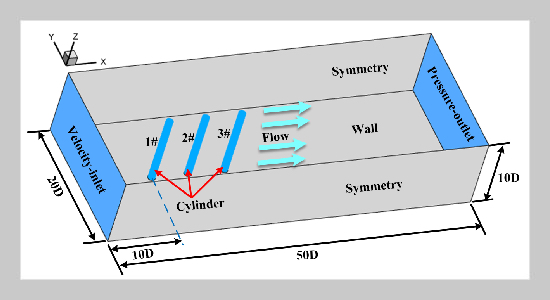
To investigate the flow field characteristics and wake vortex shedding behind cylinders during fluid flow. This study focuses on three tandem cylinders. Large Eddy Simulation (LES) is employed to analyze the effects of varying cylinder spacing ratios ( L/D = 2 ∼ 7 ) on the lift and drag coefficients ( Clrms, Cdaxg ), the time-averaged pressure coefficient ( Cp) on the cylinder surfaces, and the wake vortex shedding under subcritical Reynolds numbers ( Re = 3900, 2×10⁴, 4×10⁴. The results show that Clrms increases first and then decreases with the increase of L/D, reaching the peak at L/D = 3 Re = 4×10⁴,Clrms2 = 0.43 . When Re = 2×10⁴ ∼ 4×10⁴, Cdavg1 > Cdavg2 > Cdavg3, and Cdavg1 remains stable at around 0.5 , while Cdavg2 and Cdavg3 show a slight decreasing trend. The Cp value of the cylinder is symmetrically distributed along the f low direction, with strong negative pressure areas on both sides of the cylinder. The Cp behind the cylinder tends to-0.5. However, when Re = 3900 ∼ 4×10⁴, the Cp of the downstream 2# and 3# cylinders at L/D = 3 is greater than 0 , and the negative pressure area disappears. St increases with the increase of L/D. When L/D =3∼4,theincrease of St is relatively large ( 27.2% ). When L/D = 7, the shedding of the tail vortex of the cylinder approaches the flow around a single cylinder (St ≈ 0.2).
Keywords: Three-cylinder in tandem; Subcritical Reynolds number; Spacing ratio; Lift and drag coefficients; Flow field characteristics
[1] W. Zhai, M. Liu, C. Huang, D. Cheng, and L. Tan, (2023) “Large Eddy Simulation of Flow Characteristics around Cylinders with Crosswise and Streamwise Arrangements in Ocean Energy" Energies 16(22): 7605. DOI: 10.3390/en16227605.
[2] Y.Deng,G.Yin,L.Zhou,andG.Xi,(2022)“Experimental Study on the Influence of Spacing Ratio on the Flow around Two Parallel Circular Cylinders Close to the Wall" Mechanical Design and Manufacturing (10): 174 177+181. DOI: 10.19356/j.cnki.1001-3997.2022.10.007.
[3] X.Liu,L.Ruan,Q.Yang,H.Jiang,andA.Chen,(2024) “Wind tunnel tests for aerodynamic characteristics of multiple tandem circular cylinders" Structures 70: 107680. DOI: https: //doi.org/10.1016/j.istruc.2024.107680.
[4] Q. Yang, Q. Liu, and X. Liu, (2019) “The time-averaged pressure distribution and aerodynamic forces of the flow around three tandem cylinders" Vibration, Testing and Diagnosis 39(05): 1011–1015+1133. DOI: 10.16450/j.cnki.issn.1004-6801.2019.05.015.
[5] W.B.andX.J.,(2022)“ApplicationofDifferent Sub-Grid Models Used in Large-Eddy Simulation of Flow Around a Cylinder at Re=3900" Experimental Techniques 47(1): 187–195. DOI: 10.1007/S40799-022-00568-3.
[6] B.L.daSilva, R. D. Luciano, J. Utzig, and H. F. Meier, (2019) “Analysis of flow behavior and fluid forces in large cylinder bundles by numerical simulations" Inter national Journal of Heat and Fluid Flow 75: 209–226. DOI: https: //doi.org/10.1016/j.ijheatfluidflow.2019.01.006.
[7] X. Hu, X. Zhang, and Y. You, (2019) “On the flow around two circular cylinders in tandem arrangement at high Reynolds numbers" Ocean Engineering 189: 106301. DOI: https: //doi.org/10.1016/j.oceaneng.2019.106301.
[8] N. Hosseini, M. Griffith, and J. Leontini, (2020) “The f low past large numbers of cylinders in tandem" Journal of Fluids and Structures 98: 103103. DOI: https: //doi.org/10.1016/j.jfluidstructs.2020.103103.
[9] M. A. Prsic, M. C. Ong, B. Pettersen, andD.Myrhaug, (2019) “Large Eddy simulations of flow around tandem circular cylinders in the vicinity of a plane wall" Journal of Marine Science and Technology 24(2): 338–358. DOI: 10.1007/s00773-018-0553-3.
[10] J. Chen, P. Yu, and H. Ouyang, (2022) “Research on the Frequency Characteristics of Double Vortex Shedding Flow Patterns around Three-Dimensional Tandem Cylinders with Unequal Diameters" Journal of Applied Mechanics 39(02): 386–393.
[11] J. Liu, L. Zou, F. Tao, H. Zuo, and H. Xu, (2022) “Large Eddy Simulation Study on Flow Characteristics around Tandem Double Cone Cylinders" Acta Mechanica Sinica 54(05): 1209–1219.
[12] J. Tu, B. Cao, X. Tan, J. Liang, Z. Wang, and C. Wang, (2019) “Research on Flow Characteristics and Mutual Disturbance Effects of Tandem Double Cylinders" Journal of Applied Mechanics 36(04): 869–875+998. DOI: 10.11776/cjam.36.04.A015.
[14] C. Chang, W. Zhang, and Z. Huang, (2024) “Numerical analysis of flow interference passing through tan dem cylinders at Re = 3900" Ocean Engineering 313: 119546. DOI: https: //doi.org/10.1016/j.oceaneng.2024.119546.
[15] J. Dai, Y. Gong, K. Wang, H. Gao, and J. Mao, (2025) “Wake dynamics and turbulence structures of flow past two tandem circular cylinders near a plane wall" Ocean Engineering 334: 121575. DOI: https: //doi.org/10.1016/j.oceaneng.2025.121575.
[16] L. Chen, (2020) “An implicit large eddy simulation finite element model based on the Navier-Stokes equation residuals" Acta Mechanica Sinica 52(05): 1314–1322.
[18] T. Kitagawa and H. Ohta, (2008) “Numerical investigation on flow around circular cylinders in tandem arrangement at a subcritical Reynolds number" Journal of Fluids and Structures 24(5): 680–699. DOI: https: //doi.org/10.1016/j.jfluidstructs.2007.10.010.
[20] M. N. Amer, A. Abuelyamen, V. B. Parezanovi´c, A. K. Alkaabi, S. A. Alameri, and I. Afgan, (2025) “A com prehensive review, CFD and ML analysis of flow around tandem circular cylinders at sub-critical Reynolds numbers" Journal of Wind Engineering and Industrial Aerodynamics 257: 105998. DOI: 10.1016/j.jweia.2024.105998.
We use cookies on this website to personalize content to improve your user experience and analyze our traffic. By using this site you agree to its use of cookies.