Xiang Li1This email address is being protected from spambots. You need JavaScript enabled to view it. and Chunyan Li2
1School of Engineering, Guangzhou College of Technology and Business, Guangzhou, China
2Library, Yulin Normal University, Yulin, China
Received: December 31, 2024 Accepted: June 2, 2025 Publication Date: January 19, 2026
Copyright The Author(s). This is an open access article distributed under the terms of the Creative Commons Attribution License (CC BY 4.0), which permits unrestricted use, distribution, and reproduction in any medium, provided the original author and source are cited.
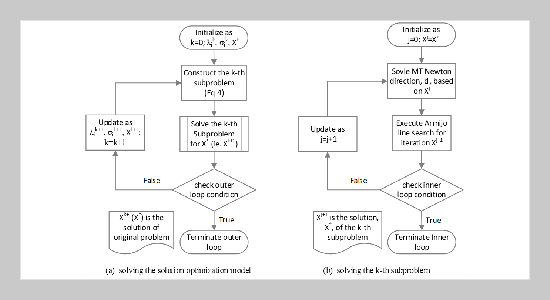
Steady-state optimization of complex process systems in engineering practice is a typical class of large-scale optimization problems. In this paper, we propose a new method, Sequential Bound Constrained Minimization (SBCM) method, for solving such optimization problems. Specifically, by introducing relaxation variables properly into engineering optimization model, the derived penalty function encompasses only penalty items related to equality constraints, excluding those pertaining to bound and inequality constraints. The solution to the original optimization problem is obtained through solving a series of bound constrained subproblems instead of a series of unconstrained subproblems. Furthermore, a modified truncated-Newton method is provided to solve the bound constrained subproblems. Finally, numerical simulations are conducted on two nonlinear optimization problems with varying dimensions and the simulation results demonstrate the stability and effectiveness of the proposed method.
[1] A. S. Drud, (1994)“CONOPT—a large-scale GRG code" ORSA Journal on computing 6(2):207–216.DOI:10.1287/ijoc.6.2.207.
[2] J. D. Pintér, (2007) “Nonlinear optimization with GAMS/LGO"JournalofGlobalOptimization38(1): 79–101.DOI:10.1007/s10898-006-9084-2.
[3] S. Smith and L.Lasdon,(1992) “Solving large sparse nonlinear programs using GRG "ORSA Journal on Computing 4(1):2–15.DOI:10.1287/ijoc.4.1.2.
[4] M.S. Siemiatkowski and M. Deja, (2021) “Planning optimised multi-tasking operations under the capability for parallel machining" Journal of Manufacturing Systems 61: 632–645. DOI: 10.1016/j.jmsy.2021.10.009.
[5] L. Sun, G. He, Y. Wang, and C. Zhou, (2011) “An ac curate active set newton algorithm for large scale bound constrained optimization" Applications of mathematics 56(3): 297–314. DOI: 10.1007/s10492-011-0018-z.
[6] F. Facchinei, J. Júdice, and J. Soares, (1998) “An active set Newton algorithm for large-scale nonlinear programs with box constraints" SIAM Journal on Optimization 8(1): 158–186. DOI: 10.1137/S1052623493253991.
[7] A. Cristofari, M. De Santis, S. Lucidi, and F. Ri naldi, (2017) “A two-stage active-set algorithm for bound constrained optimization" Journal of Optimization Theory and Applications 172(2): 369–401. DOI: 10. 1007/s10957-016-1024-9.
[8] M.ShavakhandB.Bidabad,(2022)“TIME-OPTIMAL OF FIXED WING UAV AIRCRAFT WITH INPUT AND OUTPUT CONSTRAINTS" Numerical Alge bra, Control & Optimization 12(3): DOI: 10.3934/naco.2021023.
[9] D.L.JensenandR.A.Polyak,(1994) “The convergence of a modified barrier method for convex programming" IBM Journal of Research and Development 38(3): 307–321. DOI: 10.1147/rd.383.0307.
[10] V. S. Vassiliadis and C. A. Floudas, (1997) “The modified barrier function approach for large-scale optimization" Computers & chemical engineering 21(8): 855–874. DOI: 10.1016/S0098-1354(96)00313-4.
[11] V. Vassiliadis and S. Brooks, (1998) “Application of the modified barrier method in large-scale quadratic program ming problems" Computers & chemical engineering 22(9): 1197–1205. DOI: 10.1016/S0098-1354(98)80010-0.
[12] Y. G. Acle, F. D. Freitas, and J. Y. Ishihara, (2017) “Effectiveness evaluation of the Lagrangian modified barrier function method on solving the optimal reactive power f low considering time-varying power demand" Przeglad Elektrotechniczny 93(7): DOI: 10.15199/48.2017.07.24.
[13] P. E. Gill, W. Murray, M. A. Saunders, J. A. Tomlin, and M. H. Wright, (1986) “On projected Newton barrier methods for linear programming and an equivalence to Karmarkar’s projective method" Mathematical programming 36(2): 183–209. DOI: 10.1007/BF02592025.
[14] D. Den Hertog, C. Roos, and T. Terlaky, (1992) “On the classical logarithmic barrier function method for a class of smooth convex programming problems" Journal of Optimization Theory and Applications 73(1): 1 25. DOI: 10.1007/BF00940075.
[15] X. LIANG, (2001) “Modified augmented Lagrange multiplier methods for large-scale chemical process optimization" Chinese Journal of Chemical Engineering 9(2): 167. DOI: 10.1002/apj.5500090214.
[16] R. Pytlak, (1998) “An efficient algorithm for large-scale nonlinear programming problems with simple bounds on the variables" SIAM Journal on Optimization 8(2): 532–560. DOI: 10.1137/S1052623494276518.
[17] R. H. Byrd, P. Lu, J. Nocedal, and C. Zhu, (1995) “A limited memory algorithm for bound constrained optimization" SIAM Journal on scientific computing 16(5): 1190–1208. DOI: 10.1137/0916069.
[18] G. Yuan, Z. Wei, and Z. Wang, (2013) “Gradient trust region algorithm with limited memory BFGS update for non smooth convex minimization" Computational Optimization and Applications 54(1): 45–64. DOI: 10.1007/s10589-012-9485-8.
[19] A.R.Conn,N.I.Gould,andP.L.Toint,(1988)“Global convergence of a class of trust region algorithms for optimization with simple bounds" SIAM journal on numerical analysis 25(2): 433–460. DOI: 10.1137/0725029.
[20] H. Yu. “A Smoothing Active-Set Newton Method for Constrained Optimization”. In: 2012 Fifth Inter national Joint Conference on Computational Sciences and Optimization. IEEE. 2012, 399–403. DOI: 10.1109/CSO.2012.95.
[22] Y. -J. Li and D.-H.Li,(2009)“Truncatedregularized New ton method for convex minimizations" Computational Optimization and Applications 43(1): 119–131. DOI: 10.1007/s10589-007-9128-7.
[23] S. G. Nash, (2000) “A survey of truncated-Newton methods" Journal of computational and applied mathematics 124(1-2): 45–59. DOI: 10.1016/S0377-0427(00)00426-X.
We use cookies on this website to personalize content to improve your user experience and analyze our traffic. By using this site you agree to its use of cookies.