Yi XuThis email address is being protected from spambots. You need JavaScript enabled to view it.
Chongqing City Vocational College, Yongchuan, Chongqing 402160, China
Received: August 30, 2025 Accepted: October 26, 2025 Publication Date: December 21, 2025
Copyright The Author(s). This is an open access article distributed under the terms of the Creative Commons Attribution License (CC BY 4.0), which permits unrestricted use, distribution, and reproduction in any medium, provided the original author and source are cited.
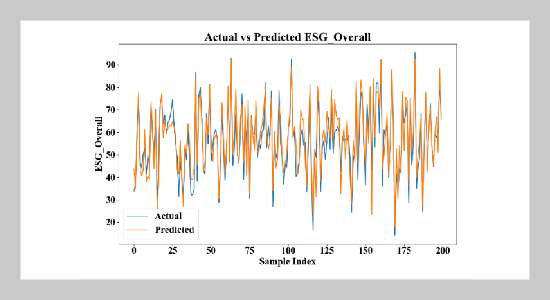
Financial Performance Evaluation is the process of assessing a company’s financial health, profitability, and growth potential using key financial indicators and metrics. The study proposes a data-driven framework for the integrated evaluation of enterprise financial performance by considering both financial and non-financial recoveries, known as Environmental, Social, and Governance (ESG). The study utilizes a dataset comprising 11,000 records from 1,000 firms, providing a robust foundation for the analysis of financial and ESG factors. Financial analysis in a traditional manner may prove inadequate in balancing the complexities of the new business environment and the ever-shifting financial data. The framework deploys Deep-Convolutional Neural Networks (DCNNs) for the prediction of future sustainability and financial scenarios. The framework uses ESG criteria along with financial parameters, thereby stretching its applications beyond short-term profit maximization for long-term viability and sustainable growth. It qualifies itself as an appropriate candidate to handle complex datasets, but also provides insightful outputs to help strategic planners in decisions ensuring both financial development and development in a responsible manner. The study stresses the impact of ESG on financial performance and shows that companies with strong sustainability aspects maintain healthy financial growth in recent years. The model achieved strong predictive accuracy, with a Mean Absolute Error (MAE) of 0.0189, Mean Squared Error (MSE) of 0.0007, and a Root Mean Squared Error (RMSE) of 0.0265, indicating highly reliable and precise forecasting capabilities. Hence, the DCNN architecture outperforms others in predicting the future of financial and sustainability metrics, thereby proving the potential of Deep Learning (DL) for evaluating financial performance.
[1] P. Weston and M. Nnadi, (2023) “Evaluation of Strategic and Financial Variables of Corporate Sustainability and ESG Policies on Corporate Finance Performance" Journal of Sustainable Finance & Investment 13(2): 1058–1074. DOI: 10.1080/20430795.2021.1883984.
[2] Y. Li, Y. Zhang, and Y. A. Solangi, (2023) “Assessing ESG Factors and Policies of Green Finance Investment Decisions for Sustainable Development in China Using the Fuzzy AHP and Fuzzy DEMATEL" Sustainability 15(21): 152115214. DOI: 10.3390/su152115214.
[3] H. Wasserbacher and M. Spindler, (2022) “Machine Learning for Financial Forecasting, Planning and Analy sis: Recent Developments and Pitfalls" Digital Finance 4(1): 63–88. DOI: 10.1007/s42521-021-00046-2.
[4] M. A. Balcı, Ö. Akgüller, L. M. Batrancea, and A. Nichita, (2024) “The Impact of Turkish Economic News on the Fractality of Borsa Istanbul: A Multidisciplinary Approach" Fractal and Fractional 8(1): 32. DOI: 10.3390/fractalfract8010032.
[5] E. V. Yaroson, S. Chowdhury, S. K. Mangla, and P. K. Dey, (2024) “Unearthing the Interplay between Organisational Resources, Knowledge and Industry 4.0 Analytical Decision Support Tools to Achieve Sustainability and Sup ply Chain Wellbeing" Annals of Operations Research 342(2): 1321–1368. DOI: 10.1007/s10479-024-05845-5.
[6] M. A. Abebo, S. Assefa, and A. W/Michael, (2024) “Performance Evaluation of the Bilate and Furfuro Irrigation Schemes in Silti Zone, Southern Ethiopia" Journal of Engineering and Applied Science 71(1): 88. DOI: 10.1186/s44147-024-00419-5.
[7] R. Zharfpeykan and C. Akroyd, (2022) “Factors Influencing the Integration of Sustainability Indicators into a Company’s Performance Management System" Journal of Cleaner Production 331: 129988. DOI: 10.1016/j.jclepro.2021.129988.
[8] E. Herman and K.-E. Zsido, (2023) “The Financial Sustainability of Retail Food SMEs Based on Financial Equilibrium and Financial Performance" Mathematics 11(15): 3410. DOI: 10.3390/math11153410.
[9] R. M. S. Cruz et al., (2022) “Bioplastics for Food Packaging: Environmental Impact, Trends and Regula tory Aspects" Foods 11(19): 3087. DOI: 10.3390/foods11193087.
[10] A. T. Alsanousi, A. Y. Alqahtani, A. A. Makki, and M. A. Baghdadi, (2024) “A Hybrid MCDM Approach Using the BWM and the TOPSIS for a Financial Performance-Based Evaluation of Saudi Stocks" Information 15(5): 258. DOI: 10.3390/info15050258.
[11] A. Jong, (2024) “Social Theory and Navigating Indeterminacy: A Configurational Analysis of Iranian Youth’s Identity Construction in Contemporary Iran" Societies 14(3): 32. DOI: 10.3390/soc14030032.
[12] A. P. Monteiro, J. Vale, E. Leite, M. Lis, and J. Kurowska-Pysz, (2022) “The Impact of Information Systems and Non-Financial Information on Company Success" International Journal of Accounting Information Systems 45: 100557. DOI: 10.1016/j.accinf.2022.100557.
[13] T. T. Adewale, T. D. Olorunyomi, and T. N. Odonkor, (2023) “Big Data-Driven Financial Analysis: A New Paradigm for Strategic Insights and Decision-Making" International Journal of Frontier Science and Technology Research 4(2): 33–54. DOI: 10.53294/ijfstr.2023.4.2.0060.
[14] A. F. Srouji, M. E. Hamdallah, R. Al-Hamadeen, M. Al-Okaily, and A. A. Elamer, (2023) “The Impact of Green Innovation on Sustainability and Financial Performance: Evidence from the Jordanian Financial Sector" Business Strategy & Development 6(4): 1037–1052. DOI: 10.1002/bsd2.296.
[15] P. K. Ozili and P. T. Iorember, (2024) “Financial Stability and Sustainable Development" International Journal of Finance & Economics 29(3): 2620–2646. DOI: 10.1002/ijfe.2803.
[16] S. Chand, H. K. Ghritlahre, and A. P. Singh, (2024) “Exergetic Performance Evaluation of Louvered Finned So lar Air Heater: An Experimental Investigation" Journal of Engineering and Applied Science 71(1): 145. DOI: 10.1186/s44147-024-00478-8.
[17] S. Rooh, H. El-Gohary, I. Khan, S. Alam, and S. M. A. Shah, (2023) “An Attempt to Understand Stock Market Investors’ Behaviour: The Case of Environmental, Social, and Governance (ESG) Forces in the Pakistani Stock Market" Journal of Risk and Financial Management 16(12): 500. DOI: 10.3390/jrfm16120500.
[18] Y. Zhao, Y. Gao, and D. Hong, (2025) “Sustainable Innovation and Economic Resilience: Deciphering ESG Ratings’ Role in Lowering Debt Financing Costs" Journal of the Knowledge Economy 16(1): 4309–4343. DOI: 10.1007/s13132-024-02129-y.
[19] Y. XuandN.Zhu, (2024) “The Effect of Environmental, Social, and Governance (ESG) Performance on Corporate Financial Performance in China: Based on the Perspective of Innovation and Financial Constraints" Sustainability 16(8): 3329. DOI: 10.3390/su16083329.
[20] W. Xiuguo and S. D. Shengyong, (2022) “An Analysis on Financial Statement Fraud Detection for Chinese Listed Companies Using Deep Learning" IEEE Ac cess 10: 22516–22532. DOI: 10.1109/ACCESS.2022.3153478.
[21] Y. Song and R. Wu, (2022) “The Impact of Financial Enterprises’ Excessive Financialization Risk Assessment for Risk Control Based on Data Mining and Machine Learning" Computational Economics 60(4): 1245–1267. DOI: 10.1007/s10614-021-10135-4.
[22] D. Wu,X.Ma,andD.L.Olson, (2022) “Financial Dis tress Prediction Using Integrated Z-Score and Multilayer Perceptron Neural Networks" Decision Support Systems 159: 113814. DOI: 10.1016/j.dss.2022.113814.
[23] E. Herman, K.-E. Zsido, and V. Fenyves, (2022) “Clus ter Analysis with K-Mean versus K-Medoid in Financial Performance Evaluation" Applied Sciences 12(16): 7985. DOI: 10.3390/app12167985.
[24] S. Kumar and P. Dua, (2022) “Environmental Management Practices and Financial Performance: Evidence from Large Listed Indian Enterprises" Journal of Environ mental Planning andManagement65(1):37–61. DOI: 10.1080/09640568.2021.1877641.
[25] H. N. Bhandari, N. R. Pokhrel, R. Rimal, K. R. Dahal, and B. Rimal, (2024) “Implementation of Deep Learning Models in Predicting ESG Index Volatility" Financial Innovation 10(1): 75. DOI: 10.1186/s40854-023-00604-0.
[26] W.-L. Hsu, Y.-L. Lin, J.-P. Lai, Y.-H. Liu, and P.-F. Pai, (2025) “Forecasting Corporate Financial Performance Using Deep Learning with Environmental, Social, and Governance Data" Electronics 14(3): 417. DOI: 10.3390/electronics14030417.
[27] N. M. Ha, P. A. Nguyen, N. V. Luan, and N. M. Tam, (2024) “Impact of Green Innovation on Environmental Performance and Financial Performance" Environment, Development and Sustainability 26(7): 17083–17104. DOI: 10.1007/s10668-023-03328-4.
[28] O. Dzomonda, (2022) “Environmental Sustainability Commitment and Access to Finance by Small and Medium Enterprises: The Role of Financial Performance and Corporate Governance" Sustainability 14(14): 8863. DOI: 10.3390/su14148863.
[29] Y. Liu, C. Y. Kim, E. H. Lee, and J. W. Yoo, (2022) “Relationship between Sustainable Management Activities and Financial Performance: Mediating Effects of Non Financial Performance and Moderating Effects of Institutional Environment" Sustainability 14(3): 1168. DOI: 10.3390/su14031168.
[30] H.I. M.AminandK.Cek,(2023) “The Effect of Golden Ratio-Based Capital Structure on Firm’s Financial Performance" Sustainability 15(9): 7424. DOI: 10.3390/su15097424.
[31] J. Bobba. Enterprise Financial Data Sharing and Security in Hybrid Cloud Environments: An Information Fusion Approach for Banking Sectors. 2021.
[32] Y. Sun, Y. Zou, J. Jiang, and Y. Yang, (2023) “Climate Change Risks and Financial Performance of the Electric Power Sector: Evidence from Listed Companies in China" Climate Risk Management 39: 100474. DOI: 10.1016/j.crm.2022.100474.
[33] B. Tutcu, M. Kayaku¸s, M. Terzio˘glu, G. F. Ünal Uyar, H. Tala¸s, and F. Yetiz, (2024) “Predicting Financial Performance in the IT Industry with Machine Learning: ROA and ROE Analysis" Applied Sciences 14(17): 7459. DOI: 10.3390/app14177459.
[34] G. Cohen, (2022) “Algorithmic Trading and Financial Forecasting Using Advanced Artificial Intelligence Methodologies" Mathematics 10(18): 3302. DOI: 10.3390/math10183302.
[35] A. A. Oyedele, A. O. Ajayi, L. O. Oyedele, S. A. Bello, and K. O. Jimoh, (2023) “Performance Evaluation of Deep Learning and Boosted Trees for Cryptocurrency Closing Price Prediction" Expert Systems with Applications 213: 119233. DOI: 10.1016/j.eswa.2022.119233.
[36] H.JingandS.Zhang,(2024)“TheImpactofArtificialIntelligence on ESG Performance of Manufacturing Firms: The Mediating Role of Ambidextrous Green Innovation" Systems 12(11): 499. DOI: 10.3390/systems12110499.
[37] Kaggle. ESG & Financial Performance Dataset. Ac cessed July 17, 2025. 2025.
We use cookies on this website to personalize content to improve your user experience and analyze our traffic. By using this site you agree to its use of cookies.