Xiaodong Jia1, Naixing Liang2, and Kaifeng Zheng3This email address is being protected from spambots. You need JavaScript enabled to view it.
1School of Urban Construction Engineering, Chongqing Open University, Chongqing 400052, China
2School of Civil Engineering, Chongqing Jiaotong University, Chongqing 400074, China
3Shenzhen Cheng Chung Design Co., Ltd., Shenzhen 518017, China
Received: June 19, 2025 Accepted: November 11, 2025 Publication Date: December 21, 2025
Copyright The Author(s). This is an open access article distributed under the terms of the Creative Commons Attribution License (CC BY 4.0), which permits unrestricted use, distribution, and reproduction in any medium, provided the original author and source are cited.
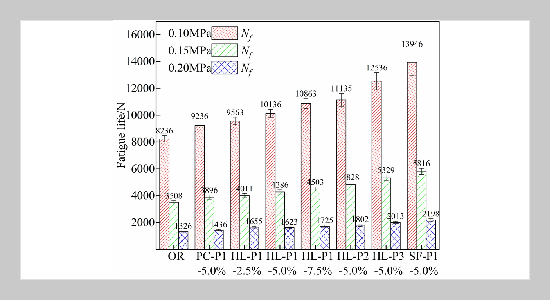
To explore the influence of inorganic-micro-powder materials on the fatigue perfor-mance of asphalt, hydrated lime (HL), silica fume (SF), and Portland cement (PC) were selected as representatives of inorganic-micro powder materials. Based on the type, content, a (1)nd particle size of inorganic-micro-powder materials, the influence of the micro-powder modifier on the fatigue performance of asphalt was analyzed by a dy-namic shear rheometer (DSR) time sweep test using dissipation energy index NDER and damage mechanics index C×Npeak. The core characteristic parameters of the mi-cro-powder that affect the fatigue life of asphalt were determined. The results show that, among the three different types of micro-powder, the influence of SF on the fatigue performance of asphalt was the most significant, followed by HL, and PC was the least influential. An increase of stress resulted in a gradual decrease of the influence of various micro-powder modifiers on the fatigue performance of asphalt. The surface area content (It refers to the surface area value of micro-powder per gram of asphalt material) of micro-powder is purported to be the core characteristic parameter affecting the fa-tigue life of asphalt, and the surface content stress fatigue equation between the fatigue life of the modified asphalt and the surface content and stress of micro-powder was established. The fatigue life prediction of micro-powder modified asphalt under the influence of different surface area content was realized.
[1] M. A. Alsheyab, M. A. Khasawneh, A. Abualia, and A.Sawalha,(2024)“A critical review of fatigue cracking in asphalt concrete pavement: a challenge to pavement durability "Innovative Infrastructure Solutions 9(10): 386–386.DOI:10.1007/s41062-024-01704-1.
[2] X. Jia, N. Liang, andY.Peng, (2022)“Analysison Fatigue Performance of Asphalt Mortar with Inorganic Micro-Powder Filler "Journal of Harbin Institute of Technology 54:148–154. DOI:10.11918/202008041.
[3] S.Dong,S.Han,Y.Yi,S.Wu,andQ.Zhang,(2021) “AdhesionofLimeModifiedAsphaltBasedonSurfaceEnergy Theory "Journal of Chongqing Jiaotong University (NaturalScience) 40:89–97.DOI:10.3969/j.issn.1674-0696.
[4] S.Han,W.Li,M.Liu,Y.Liu,andY.Ma,(2020)“Adhesion Analysis of Asphalt Mixed with Hydrated Lime Based on Surface Energy "Journal of Jiangsu University (Natural Science Edition) 41:491–496.DOI:10.3969/j.issn.1671-7775.
[5] Y. Gan, Q. Deng, C. Li, Y. Li, A. Chen, D. Wu, and F. Liu,(2025)“Activation preparation of wastetire pyrolytic carbon black and its rein forcing application in modified asphalt "Construction and Building Materials 478: 141440–141440. DOI:10.1016/j.conbuildmat.2025.141440.
[6] T. Fan, S. Han, and C. Si, (2025) “Effect of Ultraviolet Aging on Fatigue Properties of Calcium Sulfate Whisker ModifiedAsphalt " Materials Reports 39 (11):126–131. DOI:10.11896/cldb.24040015.
[7] B. Guo, X. Jia, H. Zhang, and L. Liu, (2021) “Effect of Solid Waste Filler on Fatigue Property of Modified Asphalt During Aging Process" Bulletin of the Chinese Ceramic Society 40: 2822–2830. DOI: 10.16552/j.cnki. issn1001-1625.2021.08.025.
[8] X. Xu, X. Zhang, J. Liu, and C. Zhao, (2025) “Performance evaluation of cement modified asphalt rubber binder through optimizing aging indexes" Case Studies in Construction Materials 22: e04623–e04623. DOI: 10.1016/j.cscm.2025.e04623.
[9] W.J.MohammedandM.Q.Ismael,(2024) “The Moisture Resistance of Sustainable Asphalt Mixtures Modified with Silica Fume" Journal of Ecological Engineering 25(9): 169–181. DOI: 10.12911/22998993/190927.
[10] G. Hou, Y. Xue, Z. Li, and W. Lu, (2024) “Rheological Properties of Silica-Fume-Modified Bioasphalt and Road Performance of Mixtures" Materials 17(9): 2090. DOI: 10.3390/ma17092090.
[11] C. Wang, T. Zhang, A. Li, D. Zhao, L. Liu, and Q. Chen, (2025) “State of the art review on inorganic powders modified asphalt materials: Reducing the temperature of asphalt pavement" Journal of Road Engineering 5(2): 279–296. DOI: 10.1016/j.jreng.2025.01.001.
[12] T. Guo, H. Chen, D. Tang, S. Ding, C. Wang, D. Wang, and Z. Li, (2023) “Rheological properties of composite inorganic micropowder asphalt mastic" Coatings 13(6): 168. DOI: 10.3390/coatings1306168.
[13] A. Al-Mohammedawi and K. A. Mollenhauer, (2022) “AStudyonFatigue Behaviour of Bitumen Emulsion Mas tic, Modified with Active Fillers" Springer 27: 159–165. DOI: 10.1007/978-3-030-46455-4_20.
[14] M. Song, Y. Gao, G. Li, X. Lv, Y. Zhao, X. Zhang, and H. Luo, (2025) “High-Temperature Rheological and Molecular Dynamics Analysis of Asphalt Modified with SiC Filler" Langmuir : the ACS Journal of Surfaces and Colloids 41(17): 10818–10830. DOI: 10.1021/acs.langmuir.4c05075.
[15] H. Zhao, J. Tang, H. Gao, and B. Guan, (2024) “Effect of silicon carbide powder on asphalt material properties and microwave-induced self-healing" Case Studies in Construction Materials 21: e03658–e03658. DOI: 10.1016/j.cscm.2024.e03658.
[16] B. D. Xing, W. Y. Fan, L. Han, C. Y. Zhuang, and X. B. Lv, (2020) “Effects of Filler Particle Size and Ageing on the Fatigue Behaviour of Bituminous Mastics" Construction and Building Materials 230: 117052 117061. DOI: 10.1016/j.conbuildmat.2019.117052.
[17] Z. E. Boudnani, G. Bachir, M. M’hammed, F. Silva, and J. B. Sousa, (2024) “Parallel Plate Gap Height Effect on DSR Measurements of GTR Modified Binders" Romanian Journal of Transport Infrastructure 13(2): 1–21. DOI: 10.2478/rjti-2024-0015.
[18] S. Lv, X. Peng, C. Liu, D. Ge, M. Tang, and J. Zheng, (2020) “Laboratory investigation of fatigue parameters characteristics of aging asphalt mixtures: A dissipated energy approach" Construction and Building Materials 230: 116972–116972. DOI: 10.1016/j.conbuildmat.2019. 116972.
[19] K. Li, J. Xie, and Y. Pan, (2024) “Influence of Filler/Binder Ratio on the Fatigue Behavior of Epoxy Asphalt Concrete" Journal of Physics: Conference Series 2706(1): 012050. DOI: 10.1088/1742-6596/2706/1/012050.
[20] H. Yu, Y. Deng, G. Deng, and N. Dong, (2024) “Correlations between Energy Dissipation Characteristics and the Rheological Property Degradation of Asphalt Binders" Buildings 14(1): 292. DOI: 10.3390/buildings14010292.
[21] S. Zhu. “Study on Rheological and Fatigue Properties of Asphalt-Aggregate Interface Adhesion". (mathesis). Guangzhou, China: South China University of Tech nology, 2020. DOI: 10.27151/d.cnki.ghnlu.2020. 002268.
[22] A. S. Shahsamandy, M. Alae, L. Han, K. Bao, and F. Xiao, (2024) “Temperature effect on the failure mechanism of fatigue life in rejuvenated RAP bitumen utilizing LAS method and PSE S-VECD model" Construction and Building Materials 451: 138700–138700. DOI: 10.1016/j.conbuildmat.2024.138700.
[23] H.O.Patrícia,F.M.L.Leni,H.d.N.LuisAlberto,P.E. Rogério, and S. A. Francisco Thiago, (2023) “Characterization of the fatigue behavior of asphalt binders, FAMs, and AC mixtures based on multiscale approaches and the S-VECD model" Construction and Building Materials 394: 132165. DOI: 10.1016/j.conbuildmat.2023.132165.
We use cookies on this website to personalize content to improve your user experience and analyze our traffic. By using this site you agree to its use of cookies.