Linzhi ShaoThis email address is being protected from spambots. You need JavaScript enabled to view it.
Engineering & Technical College of Chengdu University of Technology, Leshan 614007, China
Received: August 19, 2025 Accepted: October 27, 2025 Publication Date: January 19, 2026
Copyright The Author(s). This is an open access article distributed under the terms of the Creative Commons Attribution License (CC BY 4.0), which permits unrestricted use, distribution, and reproduction in any medium, provided the original author and source are cited.
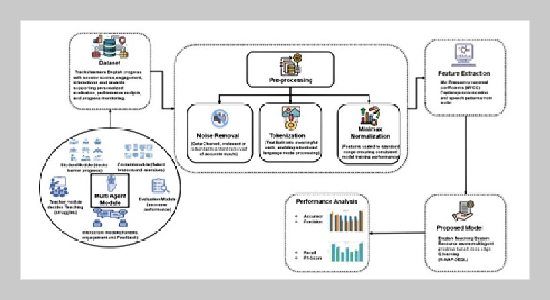
English language teaching (ELT) systems often lack personalization and adaptive feedback. Traditional English teaching methods lack personalization, real-time feedback and engagement. Integrating Multi-Agent Reinforcement Learning (MARL) offers adaptive, interactive learning environments. Agents include Teacher, Student, Content, Evaluation and Interaction modules, collaboratively learning optimal teaching strategies. Lack of reward-based personalization limits adaptive lesson selection, reduces engagement and weakens real-time feedback, hindering effective English learning. Research aims to develop a resource-aware Multi Agent Proximal tuned deep edge Q-learning (R-MAP-DEQL) framework for a personalized English teaching system. Datasets include English vocabulary, grammar exercises, reading passages and audio samples of pronunciation. Data preprocessing involves tokenization and normalization of text to standardize input and remove noise. Mel Frequency Cepstral Coefficients (MFCC) are extracted from audio samples to capture pronunciation and speech patterns. DEQL with proximal tuning enables agents to optimize policies efficiently, balancing exploration and exploitation while accounting for computational constraints and providing real-time personalized teaching interventions. The framework is implemented in Python using RL and deep learning libraries. Experiments demonstrate improved learner performance, engagement and personalized lesson adaptation. Visualizations show progressive improvement across vocabulary, grammar, reading and pronunciation metrics, confirming system effectiveness. Experimental results demonstrate that R-MAP-DEQL achieves an accuracy of 97%, a precision of 95%, a recall of 93%, and an F1-score of 96%. The proposed MARL-based English teaching system effectively personalizes learning, adapts dynamically to student performance and enhances engagement. Resource-aware multi-agent (MA) strategies ensure optimized teaching decisions. Results highlight potential for AI-driven education, scalable real-time deployment and improved language skill acquisition.
Keywords: English language teaching (ELT), Multi-Agent Reinforcement Learning (MARL), Deep edge Q-learning (DEQL), Reinforcement Learning (RL)
[1] Y. H. Jiang, R. Li, Y. Zhou, C. Qi, H. Hu, Y. Wei, B. Jiang, and Y. Wu, (2024) “AI agent for education: von Neumann multi-agent system framework" arXiv preprint arXiv:2501.00083: DOI: 10.48550/arXiv.2501.00083.
[2] C. Cai, S. Hong, M. Ma, H. Feng, S. Du, M. Chow, W. L. L. Teo, S. Liu, and X. Fan, (2025) “Analyzing the teaching and learning environments through student feedback at scale: a multi-agent LLMs framework" Education and Information Technologies: 1–33. DOI: 10.1007/s10639-025-13633-2.
[3] F. Jiang, Y. Peng, L. Dong, K. Wang, K. Yang, C. Pan, D. Niyato, and O. A. Dobre, (2024) “Large language model enhanced multi-agent systems for 6G communications" IEEE Wireless Communications: DOI: 10. 1109/MWC.016.2300600.
[4] A. Lazaridou, A. Potapenko, and O. Tieleman, (2020) “Multi-agent communication meets natural language: Synergies between functional and structural language learning" arXiv preprint arXiv:2005.07064: DOI: 10.48550/arXiv.2005.07064.
[5] L. Qian, (2022) “Research on college English teaching and quality evaluation based on data mining technology" Journal of Applied Science and Engineering 26(4): 547–556.
[6] S. Jha, S. Ahmad, H. A. Abdeljaber, A. A. Hamad, and M. B. Alazzam, (2021) “A post COVID machine learning approach in teaching and learning methodology to alleviate drawbacks of the e-whiteboards" Journal of Applied Science and Engineering 25(2): 285–294.
[7] L. Wei, (2023) “Artificial intelligence in language in struction: impact on English learning achievement, L2 motivation, and self-regulated learning" Frontiers in Psychology 14: DOI: 10.3389/fpsyg.2023.1261955.
[8] Z. Zhang, D. Zhang-Li, J. Yu, L. Gong, J. Zhou, Z. Hao, J. Jiang, J. Cao, H. Liu, Z. Liu, and L. Hou, (2024) “Simulating classroom education with LLM-empowered agents" arXiv preprint arXiv:2406.19226: DOI: 10.48550/arXiv.2406.19226.
[9] M.Wang,D.Zhang,J.Zhu,andH.Gu,(2025)“Effects of incorporating a large language model-based adaptive mechanism into contextual games on students’ academic performance, flow experience, cognitive load and behavioral patterns" Journal of Educational Computing Research 63(3): 662–694.
[10] B. R. Gudivaka, (2021) “Designing AI-assisted music teaching with big data analysis" Current Science & Humanities 9(4): 1–14.
[11] O. Hamal, E. Faddouli, and M. H. A. Harouni, (2021) “Design and implementation of the multi-agent system in education" World Journal on Educational Technology: Current Issues 13(4): 775–793.
[12] M. Liu, (2022) “Intelligent integration method of AI English teaching resource information under multi agent collaboration" Advances in Multimedia 2022(1): 1104443. DOI: 10.1155/2022/1104443.
[13] J. Wei, (2021) “Study on the effective mechanism of net work English independent learning platform based on multi-agent of big data" Information Science and Edu cation (ISE): 1073–1076. DOI: 10.1109/ICISE-IE53922.2021.00244.
[14] A. Cristea and T. Okamoto, (2000) “MyEnglishTeacher: VOD based distance academic English teaching via an adaptive, multi-agent environment" KAIS Journal:
[15] S. Xie and J. Xu, (2023) “Design and implementation of physical education teaching management system based on multi-agent model" International Journal of Computational Intelligence Systems 16(1): 172. DOI: 10.1007/s44196-023-00349-9.
[16] A. Fernández-Caballero, V. López-Jaquero, F. Montero, and P. González, (2003) “Adaptive interaction multi-agent systems in e-learning/e-teaching on the web" International Conference on Web Engineering: 144 153. DOI: 10.1007/3-540-45068-8_27.
[17] B.Wang,(2024) “Anintelligent integration method of AI English teaching resources information under multi-agent cooperation" International Journal of Continuing Engineering Education and Life Long Learning 34(1): 88–99. DOI: 10.1504/IJCEELL.2024.135266.
[18] Y. Zhai, (2025) “Computer-assisted English teaching model for improving learning performance of college students" Journal of Computational Methods in Sciences and Engineering 14727978251361524: DOI: 10.1177/14727978251361524.
[19] M. Sharif and D. Uckelmann, (2024) “Multi-modal LA in personalized education using deep reinforcement learning based approach" IEEE Access 12: 54049–54065. DOI: 10.1109/ACCESS.2024.3388474.
[20] J. Hu andG.Jin, (2024) “An intelligent framework for English teaching through deep learning and reinforcement learning with interactive mobile technology" International Journal of Interactive Mobile Technologies 18(9): DOI: 10.3991/ijim.v18i09.49289.
[21] Q.Du,(2025)“Howartificially intelligent conversational agents influence EFL learners’ self-regulated learning and retention" Education and Information Technologies: 1–67. DOI: 10.1007/s10639-025-13602-9.
[22] M. Hooda, C. Rana, O. Dahiya, A. Rizwan, and M. S. Hossain, (2022) “Artificial intelligence for assessment and feedback to enhance student success in higher education" Mathematical Problems in Engineering 2022(1): 5215722.
[23] X. Li, (2025) “Development and Implementation of an Intelligent Assisted Teaching System for Chinese English Based on Natural Language Processing and Reinforcement Learning" Computers and Education: Artificial Intelligence 100466:
[24] D. R. Rathinasamy, (2025) “The Role of Multiagent Reinforcement in Teaching English as a Second Language to Tamil Learners" International Journal of English Language Teaching 7(5): 728–738.
We use cookies on this website to personalize content to improve your user experience and analyze our traffic. By using this site you agree to its use of cookies.