- [1] Y. Wu, M. Chen, K. Wang, and G. Fu, (2019) “A dynamic information platform for underground coal mine safety based on internet of things" Safety Science 113: 9–18. DOI: 10.1016/j.ssci.2018.11.003.
- [2] F. Wang, P. Zhang, B. Cui, Z. Sun, and K. Zhang, (2021) “Research progress of disaster factors and a prevention alarm index of coal and gas outbursts" Arabian Journal of Geosciences 14: 2042. DOI: 10.1007/s12517-021-07540-2.
- [3] M. Petkovic, Y. Chen, I. Gamrath, U. Gotzes, N. S. Hadjidimitrou, J. Zittel, X. Xu, and T. Koch, (2022) “A hybrid approach for high precision prediction of gas flows" Energy Systems 13: 383–408. DOI: 10.1007/s12667-021-00466-4.
- [4] S. Li, M. You, D. Li, and J. Liu, (2022) “Identifying coal mine safety production risk factors by employing text mining and Bayesian network techniques" Process safety and environmental protection 162: 1067–1081. DOI: 10.1016/j.psep.2022.04.054.
- [5] X. Li, Z. Cao, and Y. Xu, (2025) “Characteristics and trends of coal mine safety development" Energy Sources, Part A: Recovery, Utilization, and Environmental Effects 47: 2316–2334. DOI: 10.1080/15567036.2020. 1852339.
- [6] C. Zhang, P. Wang, E. Wang, D. Chen, and C. Li, (2023) “Characteristics of coal resources in China and statistical analysis and preventive measures for coal mine accidents" International journal of coal science & technology 10: 22. DOI: 10.1007/s40789-023-00582-9.
- [7] M.S.K.Al-MarsomiaandF.M.S.Al-Zwainya,(2023) “Journal of Project Management" Journal of Project Management 8: 119–132. DOI: 10.5267/J.JPM.2022.11.002.
- [8] S. H. R. Aldhamad, R. Maya, S. F. M. Alazawy, and F. M. Alzwainy, (2024) “Forecasting models for time and cost performance predicting of infrastructural projects" Civil andEnvironmentalEngineering20:1024–1039. DOI: 10.2478/cee-2024-0074.
- [9] F. Al-Zwainy, M. G. Al-khazrajy, N. M. Hussein, S. Mohamed, M. M. Sarhan, T. J. Al-Musawi, and G. Hayder, (2024) “Utilizing Artificial Neural Networks for Predictive KPI Analysis in Bridge Projects." Journal of Computational Analysis & Applications 33:
- [10] L. L. W. Lunarzewski, (1998) “Gas emission prediction and recovery in underground coal mines" International Journal of Coal Geology 35: 117–145. DOI: 10.1016/S0166-5162(97)00007-4.
- [11] W.DongandD.Hong.“Analysis the Influence Fac tors and Deviation of Gas Outflow in Resumed Mine”. In: IOP Conference Series: Earth and Environ mental Science. 474. IOP Publishing. 2020, 042031. DOI: 10.1088/1755-1315/474/4/042031.
- [12] L. Qiu, Y. Peng, and D. Song, (2022) “Risk prediction of coal and gas outburst based on abnormal gas concentration in blasting driving face" Geofluids 2022: 3917846. DOI: 10.1155/2022/3917846.
- [13] C.Ö.Karacan, (2009) “Forecasting gob gas venthole pro duction performances using intelligent computing methods for optimum methane control in longwall coal mines" International Journal of Coal Geology 79: 131–144. DOI: 10.1016/j.coal.2009.07.005.
- [14] M. Tutak and Krenicky, (2024) “Predicting methane concentrations in underground coal mining using a multi layer perceptron neural network based on mine gas monitoring data" Sustainability 16: 8388. DOI: 10.3390/su16198388.
- [15] F. M. Al-Zwainy, S. A. Salih, M. R. Aldikheeli, et al., (2021) “Prediction of residual strength of sustainable self-consolidating concrete exposed to elevated temperature using artificial intelligent technique" International Journal of Applied Science and Engineering 18: 1 15. DOI: 10.6703/IJASE.202106_18(2).012.
- [16] J. A. Al-Somaydaii, A. T. Albadri, and F. M. Al Zwainy, (2024) “Hybrid approach for cost estimation of sustainable building projects using artificial neural net works" OpenEngineering14:20220485. DOI:10.1515/eng-2022-0485.
- [17] D. Dong, (2012) “Mine gas emission prediction based on Gaussian process model" Procedia Engineering 45: 334–338. DOI: 10.1016/j.proeng.2012.08.167.
- [18] S. Bi, L. Shao, Z. Qi, Y. Wang, and W. Lai, (2023) “Pre diction of coal mine gas emission based on hybrid machine learning model" Earth Science Informatics 16: 501 513. DOI: 10.1007/s12145-022-00894-5.
- [19] L. Ma, C. Huang, Z.-S. Liu, K. A. Morin, M. Aziz, and C. Meints, (2020) “Artificial neural network for prediction of full-scale seepage flow rate at the equity silver mine" Water, Air 231: 179. DOI: 10.1007/s11270-020-04541-x.
- [20] Y. Li, Q. Wu, and F. Lei, (2025) “Mine Water Inflow Prediction Using a CEEMDAN-OVMD-Transformer Model" Applied Sciences 15: 9710. DOI: 10.3390/app15179710.
- [21] Q.Zheng,C.Li,B.Yang,Z.Yan,andZ.Qin,(2025)“A Method for Predicting Coal-Mine Methane Outburst Volumes and Detecting Anomalies Based on a Fusion Model of Second-Order Decomposition and ETO-TSMixer" Sensors 25: 3314. DOI: 10.3390/s25113314.
- [22] S. Rathnayake, A. Rajora, and M. Firouzi, (2022) “A machine learning-based predictive model for real-time monitoring of flowing bottom-hole pressure of gas wells" Fuel 317: 123524. DOI: 10.1016/j.fuel.2022.123524.
- [23] A. S. Hati, P. Kumar, et al., (2023) “An adaptive neural fuzzy interface structure optimisation for prediction of energy consumption and airflow of a ventilation system" Applied Energy 337: 120879. DOI: 10.1016/j.apenergy.2023.120879.
- [24] Y. Wang, Y. Si, B. Huang, and Z. Lou, (2018) “Survey on the theoretical research and engineering applications of multivariate statistics process monitoring algorithms: 2008-2017" The Canadian Journal of Chemical Engineering 96: 2073–2085. DOI: 10.1002/cjce.23249.
- [25] S. Rathnayake, A. Rajora, and M. Firouzi, (2022) “A machine learning-based predictive model for real-time monitoring of flowing bottom-hole pressure of gas wells" Fuel 317: 123524. DOI: 10.1016/j.fuel.2022.123524.
- [26] S.-H. Wu, Y.-C. Zhu, Z.-H. Pan, and H. Di, (2025) “An efficient Expectation-Maximization algorithm for Bayesian operational modal analysis with physics-data fusion model" Mechanical Systems and Signal Processing 237: DOI: 10.1016/j.ymssp.2025.113144.
- [27] Y. Li and S. A. Vorobyov, (2017) “Fast algorithms for designing unimodular waveform (s) with good correlation properties" IEEE Transactions on Signal Processing 66: 1197–1212. DOI: 10.1109/TSP.2017.2787104.
- [28] S. Yang, Y. Tian, C. He, X. Zhang, K. C. Tan, and Y. Jin, (2021) “A gradient-guided evolutionary approach to training deep neural networks" IEEE Transactions on Neural Networks and Learning Systems 33: 48614875. DOI: 10.1109/TNNLS.2021.3061630.
- [29] H. K. Risan, F. M. Serhan, and A. A. Al-Azzawi. “Management of a typical experiment in engineer ing and science”. In: AIP Conference Proceedings. 2864. AIP Publishing LLC. 2024, 050001. DOI: 10.1063/5. 0186079.
- [30] F. Al-Zwainy, E. K. Abdalkarim, W. K. Majeed, E. S. Huseen, and H. S. Jari, (2024) “Development Artificial Neural Network (ANN) computing model to analyses men’s 100-meter sprint performance trends." Fizjoterapia Polska (2): DOI: 10.56984/8ZG5608M3Q.
- [31] A. Sherstinsky, (2020) “Fundamentals of recurrent neural network (RNN) and long short-term memory (LSTM) network" Physica D: Nonlinear Phenomena 404: 132306. DOI: 10.1016/j.physd.2019.132306.
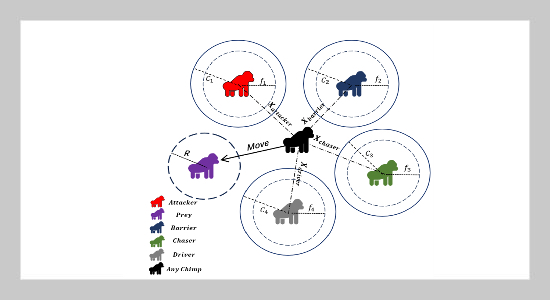
- [32] H. Jia, K. Sun, W. Zhang, and X. Leng, (2022) “An enhanced chimp optimization algorithm for continuous optimization domains" Complex & Intelligent Systems 8: 65–82. DOI: 10.1007/s40747-021-00346-5.
- [33] M. Naser, M. K. Al-Bashiti, A. T. G. Tapeh, A. Naser, V. Kodur, R. Hawileh, J. Abdalla, N. Khodadadi, A. H. Gandomi, and A. D. Eslamlou, (2025) “A review of benchmark and test functions for global optimization algorithms and metaheuristics" Wiley Interdisciplinary Reviews: Computational Statistics 17: e70028. DOI: 10.1002/wics.70028.