Yalin PangThis email address is being protected from spambots. You need JavaScript enabled to view it.
School of Electronics and Electrical Engineering, Zhengzhou University of Science and Technology, Zhengzhou 450064 China
Received: January 20, 2026 Accepted: March 1, 2026 Publication Date: March 14, 2026
Copyright The Author(s). This is an open access article distributed under the terms of the Creative Commons Attribution License (CC BY 4.0), which permits unrestricted use, distribution, and reproduction in any medium, provided the original author and source are cited.
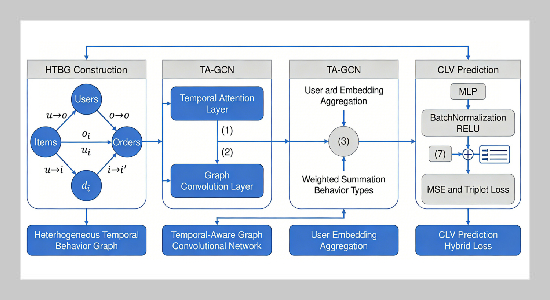
Customer Lifetime Value (CLV) prediction is a core task in retail and e-commerce, enabling enterprises to optimize resource allocation and formulate precision marketing strategies. Traditional CLV prediction methods rely heavily on manual feature engineering and fail to fully capture the sequential dependencies and complex relational patterns in user behavior data. To address this limitation, this paper proposes a graph neural network based user behavior sequence mining framework (GNN-UBSM) for CLV prediction and precision marketing. First, we construct a heterogeneous behavior graph integrating users, items, and orders to model multi-type interactions and temporal sequences. Second, a temporal-aware graph convolutional network (TA-GCN) with attention mechanism is designed to learn dynamic user embeddings by aggregating sequential behavior information. Third, a hybrid loss function combining triplet loss and regression loss is proposed to enhance the discriminability of user representations and improve CLV prediction accuracy. Extensive experiments are conducted on three real-world datasets (Amazon 5-Core, Beibei, and a proprietary e-commerce dataset). Results show that GNN-UBSM outperforms state-of-the-art methods by 3.2%−8.7% in CLV prediction error (RMSE) and 5.1%−10.3% in high-value user identification (F1-score). Furthermore, we derive a precision marketing strategy framework based on the model output, including customer segmentation, personalized recommendation, and churn prevention. This study provides both theoretical support for behavior sequence mining with GNN and practical guidance for enterprises to maximize CLV.
[1] I. A. Nugroho, K. Adi, and K. B. Aryasa, (2026) “Real-Time Conversational Analysis Using LLMs for B2B E-Commerce Customer Value Management" Engineering, Technology & Applied Science Research 16(1): 31379–31385. DOI: 10.48084/etasr.15797.
[2] A.M.HaddadiandH.Hamidi,(2025)“Ahybridmodel for improving customer lifetime value prediction using stacking ensemble learning algorithm" Computers in Human Behavior Reports 18: 100616. DOI: 10.1016/j.chbr.2025.100616.
[3] P. Chilakapati, S. Ramakrishnan, R. Deora, and A. Agarwal. “Customer Analytics: Using Machine Learning to Predict the Customer Life Time Value (CLTV) Based on Purchase History and Ratings”. In: 2025 3rd International Conference on Disruptive Tech nologies (ICDT). IEEE. 2025, 1205–1210. DOI: 10.1109/ICDT63985.2025.10986296.
[4] A. Wong, A. V. Garcia, and Y.-W. Lim, (2025) “A data driven approach to customer lifetime value prediction using probability and machine learning models" Decision Analytics Journal 16: 100601. DOI: 10.1016/j.dajour. 2025.100601.
[5] L. Teng, H. Li, and Y. Si, “Neural Tensor Network And Adaptive Graph Convolution For Sports" Journal of Applied Science and Engineering 29(6): 1483–1491. DOI: 10.6180/jase.202606_29(6).0015.
[6] Z. Khan, A. Ali, S. Aldahmani, H. Nordmark, and B. Lausen, (2025) “Customer lifetime value modelling via two stage selected trees ensembles" IEEE Access 13: 15236–115247. DOI: 10.1109/ACCESS.2025.3584709.
[7] U.Bhimavarapu. “Enhancing E-Commerce Insights Predicting CustomerLifetimeValueUsingAdvanced Neural Network Architecture”. In: Multiple-Criteria Decision-Making (MCDM) Techniques and Statistics in Marketing. IGI Global Scientific Publishing, 2025, 131 146. DOI: 10.4018/979-8-3693-9122-8.ch006.
[8] K.Monica, M. I. Habelalmateen, A. Buckshumiyan, et al. “Ensemble Learning based Categorical Boosting for Customer Lifetime Value Prediction in Busi nesses”. In: 2025 International Conference on Intelligent Systems and Computational Networks (ICISCN). IEEE. 2025, 1–5. DOI: 10.1109/ICISCN64258.2025.10934286.
[9] C. Zhao and Y. Xun, (2025) “The analysis of dynamic evaluation of online shopping satisfaction based on the re current neural network model" Scientific reports 15(1): 21724. DOI: 10.1038/s41598-025-06689-0.
[10] A. M. Agrawal. “Transforming e-commerce with Graph Neural Networks: Enhancing personalization, security, and business growth”. In: Applied Graph Data Science. Elsevier, 2025, 215–224. DOI: 10.1016/ B978-0-443-29654-3.00016-8.
[11] S. Yin, H. Li, A. A. Laghari, L. Teng, T. R. Gadekallu, and A. Almadhor, (2024) “FLSN-MVO: edge computing and privacy protection based on federated learning Siamese network with multi-verse optimization algorithm for industry 5.0" IEEE Open Journal of the Communications Society 6: 3443–3458. DOI: 10.1109/OJCOMS.2024.3520562.
[12] N. VanThieu, S. Mirjalili, H. Garg, and N. T. Hoang, (2025) “MetaPerceptron: A standardized framework for metaheuristic-driven multi-layer perceptron optimization" Computer Standards & Interfaces 93: 103977. DOI: 10.1016/j.csi.2025.103977.
[13] Q. She, C. Li, T. Tan, F. Fang, and Y. Zhang, (2025) “Improved few-shot learning based on triplet metric for motor imagery eeg classification" IEEE Transactions on Cognitive and Developmental Systems 17(4): 987 999. DOI: 10.1109/TCDS.2025.3539398.
[14] K. Balasaranya and P. Ezhumalai, (2026) “Sentiment analysis of Amazon product reviews using an inception based recurrent residual CNN approach" International Journal of Data Science and Analytics 21(1): 76. DOI: 10.1007/s41060-025-00940-7.
[15] B. Lepri, J. Staiano, G. Rigato, K. Kalimeri, A. Finnerty, F. Pianesi, N. Sebe, and A. Pentland. “The sociometric badges corpus: A multilevel behavioral dataset for social behavior in complex organizations”. In: 2012 International Conference on Privacy, Security, Risk and Trust and 2012 International Confernece on Social Computing. IEEE. 2012, 623–628. DOI: 10.1109/ SocialCom-PASSAT.2012.71.
[16] I. Aliagas, A. Gobbi, M.-L. Lee, and B. D. Sellers, (2022) “Comparison of log P and log D correction models trained with public and proprietary data sets" Journal of Computer-Aided Molecular Design 36(3): 253–262. DOI: 10.1007/s10822-022-00450-9.
[17] S. Zhang, M. Wang, W. Wang, J. Gao, X. Zhao, Y. Yang, X. Wei, Z. Liu, and T. Xu. “Glint-ru: Gated lightweight intelligent recurrent units for sequential recommender systems”. In: Proceedings of the 31st ACMSIGKDD Conference on Knowledge Discovery and Data Mining V. 1. 2025, 1948–1959. DOI: 10.1145/3690624.3709304.
[18] V. H. Koneru, X. Neufeld, S. Loth, and A. Grün. “Enhancing Recommendation Quality of the SASRec Model by Mitigating Popularity Bias”. In: Proceedings of the 18th ACM Conference on Recommender Systems. 2024, 781–783. DOI: 10.1145/3640457.3688044.
[19] T. Luo, Y. Liu, and S. J. Pan, (2024) “Collaborative sequential recommendations via multi-view GNN transformers" ACM Transactions on Information Systems 42(6): 1–27. DOI: 10.1145/3649436.
[20] H. Chen, Z. Li, Y. Bei, K. Xu, Y. Zhang, F. Huang, Y. Yang, H. Gong, and F. Karray, (2025) “Behavior Merging Graph Convolution Network for Multi-Behavior Recommendation" IEEE Transactions on Knowledge and Data Engineering 37(12): 6987–7000. DOI: 10.1109/TKDE.2025.3618466.
We use cookies on this website to personalize content to improve your user experience and analyze our traffic. By using this site you agree to its use of cookies.