Caiping LiThis email address is being protected from spambots. You need JavaScript enabled to view it.
School of Foreign Languages, Zhengzhou University of Technology, Zhengzhou, Henan 450044, China
Received: October 21, 2025 Accepted: November 27, 2025 Publication Date: March 5, 2026
Copyright The Author(s). This is an open access article distributed under the terms of the Creative Commons Attribution License (CC BY 4.0), which permits unrestricted use, distribution, and reproduction in any medium, provided the original author and source are cited.
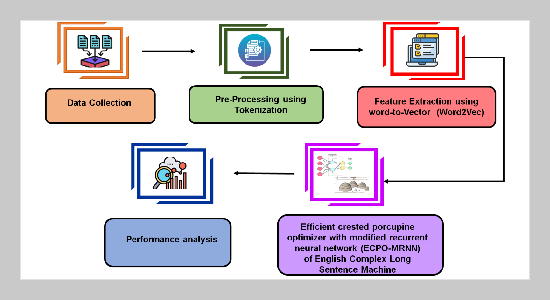
The last few years have shown a significant amount of progress in Machine translation (MT) systems, which have facilitated communication among people from different linguistic and cultural backgrounds. However, these standard MT algorithms are still not able to provide accurate translations of long, complex English sentences because of the issues related to syntax, semantics, and context that play an important role in the translation process. The research will focus on the optimization of MT algorithms which are specifically designed for complex long English sentences; by harnessing the power of big data corpora. Efficient Crested Porcupine Optimizer with Modified Recurrent Neural Network (ECPO-MRNN) to address the complexities of translating Urdu-English long and complex sentences. Data is collected from a large and diverse corpus that comprises a variety of sentence structures and contains complex and long sentences. The data is preprocessed using tokenisation for corpus data. Word-to-vector (Word2Vec) transforms words into high-dimensional vectors that capture semantic associations between words and are used to extract the features. Modified Recurrent Neural Network (MRNN) is designed to manage the intricacies of length and complex sentences by efficiently capturing long-term dependencies and contextual information, while the ECPO optimises the model’s parameters, increasing its learning capacity and advanced translation performance. The outcomes demonstrate that the conventional model improved the traditional models and accomplished a substantial development in translation quality with an outstanding boost in BLEU scores (0.214). The proposed model ECPO-MRNN provided improvements to the baseline Hierarchical Network of Concepts (HNC) model by +1.18% in average accuracy ( 95.00% ), +2.01% in recovery rate (17.39%), by 0.49 in recognition error, and +0.021 in BLEU (0.214). These findings validate its good translation performance of long and complex English sentences. Further complementary results on Urdu-English data show robustness under low-resourced conditions. The developed ECPO-MRNN model exhibited an average accuracy of 95%, a recovery rate of 17.39%, a BLEU score of 0.214, a recognition error reduction of 0.49, and a consistently lowering training loss over epochs. The outcome points out the efficiency of the ECPO-MRNN framework in perfecting the translation of lengthy and intricate English sentences, thus qualifying it as a suitable interpreter for higher-level MT applications. Ultimately, the ECPOMRNN method significantly enhances the translation of complex, lengthy English sentences and is highly adaptable across different language patterns, thus making it a feasible option for advanced MT usage.
Keywords: English Complex Long Sentence; Machine Translation (MT); Big Data Corpus; Efficient Crested Porcupine Optimiser with Modified Recurrent Neural Network (ECPO-MRNN)
1] R. Rintaningrum, (2023) “Technology integration in English language teaching and learning: Benefits and challenges" Cogent Education 10(1): 2164690. DOI: 10.1080/2331186X.2023.2164690.
[2] J. Lu, (2023) “Analysis of problem of employment and corresponding solutions for English major undergraduates" Journal of Education, Humanities and Social Sciences 18: 255–266.
[3] Y. Chen, (2023) “Analyzing the design of intelligent English translation and teaching models in colleges using data mining" Soft Computing 27(19): 14497–14513. DOI: 10.1007/s00500-023-08715-0.
[4] T. Zhang, (2020) “Recognition and segmentation of English long and short sentences based on machine translation" International Journal of Emerging Technologies in Learning 15(1): DOI: 10.3991/ijet.v15i01.12545.
[5] R. Niu and W. Yang, (2022) “Innovative system for analyzing English translation software based on IoT big data" Mobile Information Systems 2022: 1772906. DOI: 10.1155/2022/1772906.
[6] E. Nicoladis, A.Luo,andG.Vouronikos,(2024)“Com plex sentence production in bilingual and monolingual children" International Journal of Bilingual Education and Bilingualism: 1–10. DOI: 10.1080/13670050.2024.2311042.
[7] S.GuandX.Li,(2021) “Optimization of computer-aided English translation teaching based on a network teaching platform" Computer-Aided Design and Applications 19(S1): 151–160. DOI: 10.14733/cadaps.2022.S1.151-160.
[8] X.Song, (2021) “Intelligent English translation system based on evolutionary multi-objective optimization algorithm" Journal of Intelligent & Fuzzy Systems 40(4): 6327–6337. DOI: 10.3233/JIFS-202614.
[9] T. Zhang, (2022) “Deep learning classification model for English translation styles introducing attention mechanism" Mathematical Problems in Engineering 2022: 6798505. DOI: 10.1155/2022/6798505.
[10] F. Shang and Y. Li, (2024) “Exploring english long sentence translation methods by applying natural language processing techniques" Applied Mathematics and Nonlinear Sciences 9(1): DOI: 10.2478/amns.2023.2.01352.
[11] Y. Lin. “An automatic assessment and optimization algorithm for English translation software combining deep learning and NLP”. In: 2024 International Conference on Electrical Drives, Power Electronics & En gineering (EDPEE). IEEE, 2024, 226–231. DOI: 10.1109/EDPEE61716.2024.10589234.
[12] X. Yang, Y. Ma, and P. Pei. “English translation system assisted by machine learning and cloud computing data aggregation algorithm”. In: 2024 Third Inter national Conference on Distributed Computing and Elec trical Circuits and Electronics (ICDCECE). IEEE, 2024, 1–5. DOI: 10.1109/ICDCECE60474.2024.10592177.
[13] I. Safder, M. Abu Bakar, F. Zaman, H. Waheed, N. R. Aljohani, R. Nawaz, and S. U. Hassan, (2024) “Trans forming language translation: A deep learning approach to Urdu–English translation" Journal of Ambient Intelligence and Humanized Computing 15(10): 3651 3662. DOI: 10.1007/s12652-023-04927-3.
[14] X. Zhou andC. Shi, (2024) “Optimization of automatic English translation system in cross-border trade based on deep learning" Journal of Computational Methods in Science and Engineering: DOI: 10.3233/JCM-230497.
[15] M. N. U. Hassan, Z. Yu, J. Wang, Y. Li, S. Gao, S. Yang, and C. Mao, (2024) “LKMT: Linguistics knowledge driven multi-task neural machine translation for Urdu and English" Computers, Materials and Continua 81(1): 951–969. DOI: 10.32604/cmc.2024.049303.
[16] R. Batool and T. Saleem, (2023) “Comparative construction morphology of diminutive forms in English and Urdu" Cogent Arts & Humanities 10(1): 2238998. DOI: 10.1080/23311983.2023.2238998.
[17] S. Bi, (2020) “Intelligent system for English translation using automated knowledge base" Journal of Intelligent & Fuzzy Systems 39(4): 5057–5066. DOI: 10.3233/JIFS-189123.
[18] D. Tang and Z. Chen. “English long sentence ma chine translation algorithm based on U-Net GAN”. In: 2024 Second International Conference on Data Science and Information System (ICDSIS). IEEE, 2024, 1–5. DOI: 10.1109/ICDSIS61012.2024.10577641.
[19] A. Kulkarni, V. S. B. H. Gollavilli, Z. Alsalami, M. K. Bhatia, S. Jovanovska, and M. N. Absur. “Leveraging deep learning for improved sentiment analysis in NLP”. In: 2024 3rd Odisha International Conference on Electrical Power Engineering, Communication and Computing Technology (ODICON). IEEE, 2024, 1–6. DOI: 10.1109/ODICON61027.2024.10587412.
[20] L. Zhou, (2023) “English-Chinese corpus collection and AI translation based on dynamic clustering model" Inter national Journal of Science and Engineering Applications 148(58): 63–69. DOI: 10.7753/IJSEA1202.1029.
[21] Y. Wang, L. Yang, and Z. Lun, (2024) “Big data mining analysis technology for natural language processing robot design" Journal of Applied Science and Engineering 27(12): 3677–3686. DOI: 10.6180/jase.202412_27(12).0007.
[22] F. Wu, (2024) “English vocabulary learning aid system using digital twin WGAN" Applied Artificial Intelligence 38(1): 2327908. DOI: 10.1080/08839514.2024.2327908.
[23] Y. Zhang, S. Xu, H. Chen, U. A. Bhatti, and M. Huang, (2024) “Context-aware environment online monitoring for safety autonomous vehicle systems" Journal of Cloud Computing 13(1): 6. DOI: 10.1186/s13677 023-00527-4.
[24] X. Sun, U. A. Bhatti, and M. Huang. “EF-UV: Feature enhanced fusion of U-Net and ViT transformer for brain tumor MRI segmentation”. In: Deep Learning for Multimedia Processing Applications. 2024. DOI: 10.21203/rs.3.rs-5329372/v1.
[25] A. Ali, J. Li, H. Chen, U. A. Bhatti, and A. Khan, (2023) “Real-time spammers detection based on metadata features" Intelligent Automation & Soft Computing 38(3): DOI: 10.32604/iasc.2023.037382.
[26] J. Cao, U. A. Bhatti, S. Feng, M. Huang, and A. Has nain. “Air quality index predictions with a hybrid forecasting model”. In: 2023 IEEE International Conference on Pattern Recognition and Artificial Intelligence. 2023. DOI: 10.1109/PRAI59366.2023.10332062.
[27] M. Yu, Z. Zeng, H. Tang, Y. Zhang, Y. Ao, U. A. Bhatti, and A. Fahim. “Research on shellfish text entity ex traction method based on pre-trained models”. In: Youth Academic Annual Conference of the Chinese Association of Automation. 2024. DOI: 10.1109/YAC63405. 2024.10598803.
We use cookies on this website to personalize content to improve your user experience and analyze our traffic. By using this site you agree to its use of cookies.