Thanh-Lam Bui1, Duc-Quang Nguyen1, Vu-Hai Luu1, Dinh-Hieu Phan1, and Thai-Viet Dang2This email address is being protected from spambots. You need JavaScript enabled to view it.
1School of Mechanical & Automotive Engineering, Hanoi University of Industry, Hanoi, 110000, Vietnam
2School of Mechanical Engineering, Hanoi University of Science and Technology, Hanoi, 112400, Vietnam
Received: October 30, 2025 Accepted: January 3, 2026 Publication Date: February 1, 2026
Copyright The Author(s). This is an open access article distributed under the terms of the Creative Commons Attribution License (CC BY 4.0), which permits unrestricted use, distribution, and reproduction in any medium, provided the original author and source are cited.
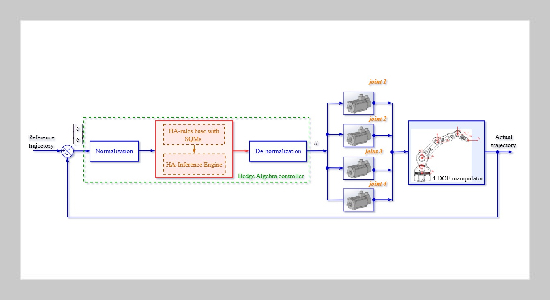
We propose TC-SRRTHAC for real-time motion planning and tracking in dynamic environments. A trackability constraint (TC) prunes the search to trajectories that are executable under controller limits on velocity, acceleration, and bandwidth, while enforcing collision safety. On this basis, the TC-SRRT planner performs spatiotemporal planning with moving obstacles and timing constraints, using goal-region expansion, conditional sampling, and efficient rewiring to find feasible collision-free paths with reduced arrival time. For trajectory tracking, a Hedge Algebra Controller (HAC) employs a semantically structured linguistic representation. In simulation and hardware experiments on a 4-DOF manipulator, TC-SRRT*HAC achieves RMSEs of 0.96−1.72 mm and 1.45−2.08 mm, respectively, with 23% lower tracking error and 10% lower control energy than an FLC baseline, while keeping planning latency below 200 ms-supporting its use in precision industrial automation under dynamic conditions.
[1] Y. Tang, M. A. Zakaria, and M. Younas, (2025) “Path Planning Trends for Autonomous Mobile Robot Navigation: A Review" Sensors 25(4): 1206. DOI: 10.3390/s25041206.
[2] G. Liu, Z. Wang, and G. Wu, (2025) “Research on Motion Planning and Tracking Control of a Redundant Degree-of-Freedom Manipulator" Journal of Mechanical Science and Technology 39(5): DOI: 10.1007/s12206-025-0444-6.
[3] H. Ji, C. Wang, C. Wang, and H. Xie, (2025) “Motion planning for hyper-redundant manipulator systems: combining path following and improved APF-RRT* Path finding" Complex & Intelligent Systems 11(10): 441.
[4] T.-V. Dang and P. X. Tan, (2024) “Hybrid mobile robot path planning using safe JBS-A* B algorithm and improved DWA based on monocular camera" Journal of Intelligent & Robotic Systems 110(4): 151.
[5] H.-L. Pham, N.-N. Bui, and T.-V. Dang, (2025) “Hybrid Path Planning for Wheeled Mobile Robot Based on RRT-star Algorithm and Reinforcement Learning Method" Journal of Robotics and Control (JRC) 6(4): 2045–2051.
[6] J. D. Gammell, S. S. Srinivasa, and T. D. Barfoot. “In formed RRT*: Optimal sampling-based path planning focused via direct sampling of an admissible ellipsoidal heuristic”. In: 2014 IEEE/RSJ international conference on intelligent robots and systems. IEEE. 2014, 2997–3004.
[7] Y. Lin and L. Zhang, (2024) “An improved Quick Informed-RRT* algorithm based on hybrid bidirectional search and adaptive adjustment strategies" Intelligent Service Robotics 17(4): 847–870.
[8] A. H. Qureshi and Y. Ayaz, (2016) “Potential functions based sampling heuristic for optimal path planning" Autonomous Robots 40(6): 1079–1093.
[9] B. Liao, F. Wan, Y. Hua, R. Ma, S. Zhu, and X. Qing, (2021) “F-RRT*: An improved path planning algorithm with improved initial solution and convergence rate" Ex pert Systems with Applications 184: 115457.
[10] H. Li, Y. Kang, and H. Han, (2024) “Dynamic Informed Bias RRT*-Connect: Improving Heuristic Guidance by Dynamic Informed Bias Using Hybrid Dual Trees Search" Journal of Intelligent & Robotic Systems 110(3): 106.
[11] A. Lonklang and J. Botzheim, (2022) “Improved Rapidly Exploring Random Tree with Bacterial Mutation and Node Deletion for Offline Path Planning of Mo bile Robot" Electronics 11(9): 1459. DOI: 10.3390/electronics11091459.
[12] D.ZhengandP.Tsiotras.“AcceleratingKinodynamic RRT* Through Dimensionality Reduction”. In: 2021 IEEE/RSJ International Conference on Intelligent Robots and Systems (IROS). Prague, Czech Republic: IEEE, 2021, 3674–3680. DOI: 10.1109/IROS51168.2021.9636754.
[13] C.H.NguyenandW.Wechler,(1990)“HedgeAlgebras: An Algebraic Approach to Structure of Sets of Linguistic Truth Values" Fuzzy Sets and Systems 35(3): 281–293. DOI: 10.1016/0165-0114(90)90036-T.
[14] M.AkramandI.Ullah, (2024) “Solution of Z-number based multi-objective linear programming models with different membership functions" Information Sciences 659: 120100.
[15] Z. Hu, H. Norouzi, M. Jiang, S. Dadfar, and T. Kashi wagi, (2022) “Novel Hybrid Modified Krill Herd Algorithm and Fuzzy Controller Based MPPT to Optimally Tune the Member Functions for PV System in the Three Phase Grid-Connected Mode" ISA Transactions 129: 214–229. DOI: 10.1016/j.isatra.2022.02.009.
[16] T. A. Mai, T. S. Dang, D. T. Duong, V. C. Le, and S. Banerjee, (2021) “A Combined Backstepping and Adaptive Fuzzy PID Approach for Trajectory Tracking of Autonomous Mobile Robots" Journal of the Brazilian Society of Mechanical Sciences and Engineering 43(3): 1–15. DOI: 10.1007/s40430-020-02767-8.
[17] Z. Zhang, X. Liu, M. Ning, X. Li, W. Liu, and Y. Lu, (2025) “A Review of Motion Planning for Redundant Space Manipulators" Science China Technological Sciences 68(3): 1310401. DOI: 10.1007/s11431-024-2841-y.
[18] T.-L. Bui, V.-T. Nguyen, N.-N. Bui, and T.-V. Dang, (2026) “Four-Wheeled Omnidirectional Mobile Robots Strategy of Navigation Using Hybrid HPSO-GA-PID Controller-Based YOLO3D-CSSA Network" Intelligent Service Robotics 19(3): DOI: 10.1007/s11370-025 00669-z.
[19] D. Vukadinovi´c, M. Baši´c, C. H. Nguyen, N. L. Vu, and T. D. Nguyen, (2014) “Hedge-Algebra-Based Volt age Controller for a Self-Excited Induction Generator" Control Engineering Practice 30: 78–90. DOI: 10. 1016/j.conengprac.2014.05.006.
[20] H.-L. Bui, T.-D. Nguyen, and V.-D. Le. “Optimal De sign of Hedge-Algebras-Based Controller for Active SuspensionSystemswithParameterUncertainty”.In: Advances in Information and Communication Technology. Lecture Notes in Networks and Systems. Springer, 2024, 163–170. DOI: 10.1007/978-3-031-50818-9\_20.
[21] H.-L. Bui, T.-A. Le, and V.-B. Bui, (2017) “Explicit Formula of Hedge-Algebras-Based Fuzzy Controller and Applications in Structural Vibration Control" Applied Soft Computing 60: 150–166. DOI: 10.1016/j.asoc. 2017.06.045.
[22] N.S. Tai, T. T. Mac, L. M. Quan, and B. Q. Dat, (2024) “A Novel Hedge Algebra Formation Control for Mobile Robots" Robotics and Autonomous Systems 172: 104607. DOI: 10.1016/j.robot.2023.104607.
[23] T.-L. Bui, T.-H. Nguyen, and X.-T. Nguyen, (2023) “A Controller for Delta Parallel Robot Based on Hedge Algebras Method" Journal of Robotics 2023: 1–20. DOI: 10.1155/2023/2271030.
[24] M. W. Spong, S. Hutchinson, and M. Vidyasagar, (2022) “Robot Modeling and Control, Second Edition [Bookshelf]" IEEE Control Systems 42(1): 126–128. DOI: 10.1109/MCS.2021.3122271.
We use cookies on this website to personalize content to improve your user experience and analyze our traffic. By using this site you agree to its use of cookies.