Dac-Duc NguyenThis email address is being protected from spambots. You need JavaScript enabled to view it. and Ba-Thanh Vu
Faculty of Civil Engineering, University of Transport and Communications, Hanoi, Vietnam
Received: July 21, 2025 Accepted: January 3, 2026 Publication Date: February 14, 2026
Copyright The Author(s). This is an open access article distributed under the terms of the Creative Commons Attribution License (CC BY 4.0), which permits unrestricted use, distribution, and reproduction in any medium, provided the original author and source are cited.
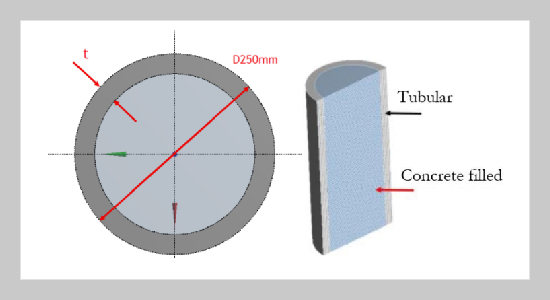
In recent years, the construction industry has made great strides in building complex projects and overcoming obstacles and challenges that require technical and high-tech solutions. However, obstacles still need to be addressed to reduce construction time, especially for reinforced concrete structures, introduce the exploitation process, and enhance investment efficiency. The construction of reinforced concrete structures involves a sequential process encompassing steel reinforcement installation, formwork assembly, and concrete casting. Investigating methodologies that reduce construction durations for enhanced economic efficacy is a good approach. This research systematically assesses the applicability of higher concrete formwork in conjunction with a standard concrete core, typically applied to cylindrical compression-bearing elements. The methodology employs a dual-pronged approach, encompassing numerical simulation, the finite element method, and experimental compression testing of specimens with varying concrete shell thicknesses (15 mm,20 mm, and 25 mm) before the infusion of concrete into the core. The horizontal and vertical strain results of both experimental and simulation showed a harmonious correlation between tubular thickness, the interplay of concrete strength in the tubular and core, a comprehensive examination of the structural component’s operational conditions, and an analysis of vertical and horizontal deformations in the external tubular.
[1] D. D. Nguyen and V. H. Tran, (2025) “Repair and Strengthening of Cantilever Continuous Bridges using External Prestressed Cables: The Case Study of the Tan De Bridge in Vietnam" Engineering, Technology Ap plied Science Research 15(01): 20005–20011. DOI: 10.48084/etasr.9536.
[2] D.D.Nguyen, (2025) “Evaluating and Strengthening Simple Span Girder Bridge for Heavy Lift Transportation: A Case Study of a Single Span Bridge with T Section Reinforced Concrete" Engineering, Technology Applied Science Research 15(03): 23027–23033. DOI: 10.48084/etasr.10628.
[3] D. A. N. P. A. Kirby. Design for structural stability. John Wiley and Sons. New York, 1979.
[4] N. D. Duc and H. N. Minh. “Investigation on the effect of cross beams in single span bridges under dynamic aspect by using finite element method”. In: 4th International Conference on Sustainability in Civil Engineering ICSCE 2022, Hanoi. 2022.
[5] N. D. Duc, N. N. Long, T. D. Nhiem, and L. B. A. Do Anh Tu, (2019) “Behavior of segmental box-girder bridge under eccentric loading" Transport and Communications Science Journal 70(5): 440–450. DOI: 10.25073/tcsj.70.5.8.
[6] D. Dac, N. Ngoc, and N. Duc, (2019) “Simulation the effect of torsion on the shear key in segmental box-girder bridges" Transport and Communications Science Journal 70(5): 386–396. DOI: 10.25073/tcsj.70.5.3.
[7] S. Jayaganesh, J. Raja Murugadoss, G. Ganesh Prabhu, and J. Jegan, (2015) “Effects of Concentrical Partial (Local) Compression on the Structural Behaviour of Concrete Filled Steel Tubular Column" Advances in Materials Science and Engineering 2015: 1–9. DOI: 10.1155/2015/491038.
[8] D.-D. Nguyen, (2025) “Optimisation of box girder bridge widening techniques: Reinforced Rib vs. Strut solutions" Applications in Engineering Science 22(2025): 3100228, 2025. DOI: 10.1016/j.apples.2025.100228.
[9] T. E. D. INC. Technical design of Dong Tru bridge, on Highway 5, Hanoi capital, Vietnam. Technical design of Dong Tru bridge. Hanoi, Vietnam, 2004.
[10] K. H. K. Weina Meng, (2016) “Development of Stay-in Place Formwork Using GFRP Reinforced UHPC" First International Interactive Symposium on UHPC (2016): DOI: 10.21838/uhpc.2016.28.
[11] Y. Yang, B. Chen, Y. Chen, H. Zhou, F. Liu, X. Xie, J. Chen, W. Guo, and H. Wang, (2023) “Performances of Concrete Columns with Modular UHPC Permanent Formworks under Axial Load" International Journal of Concrete Structures 17(38): DOI: 10.1186/s40069 023-00608-1.
[12] J.-J. Zeng, S.-P. Chen, K.-D. Peng, and J.-G. Dai, (2022) “Novel FRP micro-bar reinforced UHPC permanent form work for circular columns: Concept and compressive behavior" Composite Structures 285: 115268. DOI: 10.1016/j.compstruct.2022.115268.
[13] A.A.3.-0. American Concrete Institute. Guide to Form work for Concrete. 2004.
[14] G. B. Kim. “Development of thin FRP GFRC permanent formwork systems". (phdthesis). University of Sheffield, Department of Civil and Structural Engineering, 2006.
[15] C. K. Leung and Q. Cao, (2010) “Development of pseudo-ductile permanent formwork for durable concrete structures" Materials and Structures 43: 993–1007. DOI: 10.1617/s11527-009-9561-4.
[16] C. Yu. “The study of reinforced pseudo-ductile cementitious composite permanent formwork". (phdthesis). Hong Kong University of Science and Technology, HK, 2014. DOI: 10.14711/thesis-b1334180.
[17] L. Liu, Z. He, X. Wang P.and Cai, D. Han, and T. Luo, (2023) “Axial compression behaviour of novel concrete filled circular CFRP-UHPC composite tubular" Acta Materiae Compositae Sinica 40(4): DOI: 10.13801/j.cnki.fhclxb.20220623.003.
[18] H. Tian, Z. Zhou, Y. Wei, and L. Zhang, (2021) “Experimental and numerical investigation on the seismic performance of concrete-filled UHPC tubular columns" Journal of Building Engineering 43: 103118. DOI: 10.1016/j.jobe.2021.103118.
[19] H. Tian, Z. Zhou, Y. Wei, and L. Zhang, (2025) “Re search On Determining The Correlation Between The Strength Of The Concrete Core And The Concrete Used As Tubular Formwork In Compressed Structural Elements" Journal of Applied Science and Engineering 19(2): 267–278. DOI: 10.6180/jase.202602_29(2).0003.
[20] A. C39-04a, (2023) “Standard Test Method for Compressive Strength of Cylindrical Concrete Specimens" Ameri can Society for Testing and Materials, USA:
[22] T. 12209:2018. Self-compacting concrete- Specification and test method. Vietnamese Standard. Hanoi, Vietnam, 2018.
[23] A. K. Kwan and I. Y. Ng, (2008) “Performance Crite ria for Self consolidating Concrete" HKIE Transactions 15(2): 35–41. DOI: 10.1080/1023697X.2008.10668116.
[24] T. 3118:2022. Hardened concrete- Test method for com pressive strength. Vietnamese Standard. Hanoi, Vietnam, 2022.
[25] T. 1. 2020. Concrete- Method for determining concrete strength on samples. Vietnamese Standard. Hanoi, Vietnam, 2020.
[26] A. Inc. ANSYS Mechanical Tutorial. ANSYS Inc. Canonsburg, 2019.
[27] M.Mohamad,I.Ibrahim,R.Abdullah,A.A.Rahman, A. Kueh, and J. Usman, (2015) “Friction and cohesion coefficients of composite concrete-to-concrete bond" Cement and Concrete Composites 56: 1–14. DOI: 10.1016/j.cemconcomp.2014.10.003.
We use cookies on this website to personalize content to improve your user experience and analyze our traffic. By using this site you agree to its use of cookies.