Kongduo Xing, Bing Zheng, Haifeng LuThis email address is being protected from spambots. You need JavaScript enabled to view it., Yupeng Hu, and Ting Liu
College of Information Engineering, Hainan Vocational University of Science and Technology, Haikou 571128, Hainan, China
Received: May 21, 2025 Accepted: October 17, 2025 Publication Date: December 21, 2025
Copyright The Author(s). This is an open access article distributed under the terms of the Creative Commons Attribution License (CC BY 4.0), which permits unrestricted use, distribution, and reproduction in any medium, provided the original author and source are cited.
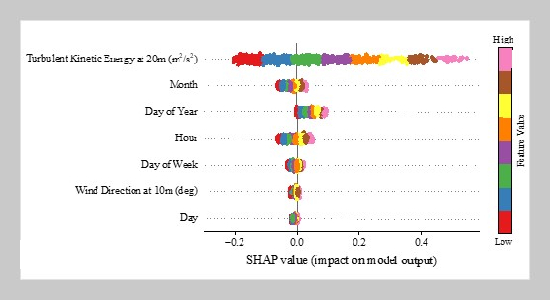
For wind energy systems to operate, plan, and be reliable, accurate wind speed forecasts are essential. Conventional methods frequently have low accuracy or processing inefficiency, which limits their use in real-time situations. this study proposes a Multi Layer Perceptron (MLP)-based Deep Learning (DL) model that is optimized using the Northern Goshawk Optimization Algorithm (NGOA). Unlike existing work, the model utilizes merely meteorological and temporal features, wind speed, wind direction, turbulent kinetic energy, and calendar-based variables. It employed a Florida subset of the NREL WIND Toolkit of sequential instances with a 75%−25%sequential split to preserve temporal order and prevent data leakage. Six models—basic MLP, deep MLP, wide MLP, shallow MLP, dropout MLP, and deep-dropout MLP-were trained and evaluated. Of all models that were compared, the NGOA-deep MLP performed the best, recording the lowest test errors and highest explanatory power, achieving a Coefficient of determination ( R2 ) of 0.9530 in training, and 0.9082 in testing, also Explained Variance (EV) of 0.9532 . Interestingly, turbulent kinetic energy and diurnal cycles (hour of day) were the best predictors, according to Shapley Additive Explanation. With 3-7 seconds for train times and 1-2 seconds for test times, the NGOA-tuned deep MLP architecture is both accurate and computationally efficient, making it practical for real-time wind speed forecasting. Its application can enhance grid stability, energy scheduling, and cost-efficient management in renewable wind power systems.
[1] R.Janho, (2020) “Renewable energy in Kenya: An examination of the legal instruments and institutional changes that successfully attracted foreign investment" Energy Central:
[2] N. Bokde, A. Feijóo, D. Villanueva, and K. Kulat, (2019) “A review on hybrid empirical mode decomposition models for wind speed and wind power prediction" Energies 12: 254. DOI: https: //doi.org/10.3390/en12020254.
[3] M.Santhosh,C.Venkaiah,andD.M.V.Kumar,(2020) “Current advances and approaches in wind speed and wind power forecasting for improved renewable energy integration: A review" Engineering Reports 2: e12178. DOI: https: //doi.org/10.1002/eng2.12178.
[4] S. Hanifi, X. Liu, Z. Lin, and S. Lotfian, (2020) “A critical review of wind power forecasting methods—past, present and future" Energies 13: 3764. DOI: https: //doi.org/10.3390/en13153764.
[5] A.CoutoandA.Estanqueiro, (2022) “Enhancing wind power forecast accuracy using the weather research and forecasting numerical model-based features and artificial neuronal networks" Renewable Energy 201: 1076–1085. DOI: https: //doi.org/10.1016/j.renene.2022.11.022.
[6] K. R. S. Preethaa, A. Muthuramalingam, Y. Natarajan, G. Wadhwa,andA.A.Y.Ali, (2023) “A comprehensive review on machine learning techniques for forecasting wind flow pattern "Sustainability15:12914. DOI: https: //doi.org/10.3390/su151712914.
[7] L. Donadio, J. Fang, and F. Porté-Agel, (2021) “Numerical weather prediction and artificial neural network coupling for wind energy forecast" Energies 14: 338. DOI: https: //doi.org/10.3390/en14020338.
[8] C. CeylanandZ.Yumurtacı, (2025) “Precision forecasting for hybrid energy systems using five deep learning algorithms for meteorological parameter prediction" International Journal of Electrical Power & Energy Systems 170: 110945. DOI: https: //doi.org/10.1016/j.ijepes.2025.110945.
[9] A. D. A. B. A. Sofian, H. R. Lim, H. S. H. Munawaroh, Z. Ma, K. W. Chew, and P. L. Show, (2024) “Machine learning and the renewable energy revolution: Exploring solar and wind energy solutions for a sustainable future including innovations in energy storage" Sustainable Development 32: 3953–3978. DOI: https: //doi.org/10.1002/sd.2885.
[10] D. Zafirakis, G. Tzanes, and J. K. Kaldellis, (2019) “Forecasting of wind power generation with the use of artificial neural networks and support vector regression models" Energy Procedia 159: 509–514. DOI: https: //doi.org/10.1016/j.egypro.2018.12.007.
[11] C. Yildiz, H. Acikgoz, D. Korkmaz, and U. Budak, (2021) “An improved residual-based convolutional neural network for very short-term wind power forecasting" Energy Conversion and Management 228: 113731. DOI: https: //doi.org/10.1016/j.enconman.2020.113731.
[12] K. T. Ate¸s, (2023) “Estimation of short-term power of wind turbines using artificial neural network (ANN) and swarm intelligence" Sustainability 15: 13572. DOI: https: //doi.org/10.3390/su151813572.
[13] G. V. Drisya and K. S. Kumar, (2022) “A Wavelet, AR and SVM based hybrid method for short-term wind speed prediction" arXiv preprint arXiv:2203.15298: DOI: https: //doi.org/10.48550/arXiv.2203.15298.
[14] A. A. Shah, A. A. Aftab, X. Han, M. H. Baloch, M. S. Honnurvali, and S. T. Chauhdary, (2023) “Prediction Error-Based Power Forecasting of Wind Energy System Using Hybrid WT–ROPSO–NARMAX Model" Energies 16: 3295. DOI: https: //doi.org/10.3390/en16073295.
[15] M. M. Rahman, M. Shakeri, F. Khatun, S. K. Tiong, A. A. Alkahtani, N. A. Samsudin, N. Amin, J. Pasupuleti, and M. K. Hasan, (2023) “A comprehensive study and performance analysis of deep neural network based approaches in wind time-series forecasting" Journal of Reliable Intelligent Environments 9: 183–200. DOI: https: //doi.org/10.1007/s40860-021-00166-x.
[16] P. V. Sireesha and S. Thotakura, (2024) “Wind power prediction using optimized MLP-NN machine learning forecasting model" Electrical Engineering 106: 7643 7666. DOI: https: //doi.org/10.1007/s00202-024-02440-6.
[17] S. Samadianfard, S. Hashemi, K. Kargar, M. Izadyar, A. Mostafaeipour, A. Mosavi, N. Nabipour, and S. Shamshirband, (2020) “Wind speed prediction using a hybrid model of the multi-layer perceptron and whale optimization algorithm" Energy Reports 6: 1147–1159. DOI: https: //doi.org/10.1016/j.egyr.2020.05.001.
[18] T. ˙ Inaç, E. Dokur, and U. Yüzgeç, (2022) “A multi strategy random weighted gray wolf optimizer-based multi-layer perceptron model for short-term wind speed forecasting" Neural Computing and Applications 34: 14627–14657. DOI: https: //doi.org/10.1007/s00521-022-07303-4.
[19] Y. Fei, X. Zeng, and G. Gao. “Short-term wind power prediction of nuclear extreme learning ma chine based on improved northern goshawk optimization algorithm”. In: International Conference on Physics, Photonics, and Optical Engineering (ICPPOE 2024). 13552. SPIE, 2025, 913–920. DOI: https: //doi.org/10.1117/12.3059976.
[20] C. Draxl, J. Wang, L. Sheridan, C. Jung, N. Bodini, S. Buckhold, C. T. Aghili, K. Peco, R. Kotamarthi, and A. Kumler. Wtk-led: The wind toolkit long-term ensemble dataset. 2024. DOI: https: //doi.org/10.2172/2473210.
[21] C. Draxl, A. Clifton, B.-M. Hodge, and J. McCaa, (2015) “The wind integration national dataset (wind) toolkit" Applied Energy 151: 355–366. DOI: https: //doi.org/10.1016/j.apenergy.2015.03.121.
[22] B.Raheli, M. T. Aalami, A. El-Shafie, M. A. Ghorbani, and R. C. Deo, (2017) “Uncertainty assessment of the multilayer perceptron (MLP) neural network model with implementation of the novel hybrid MLP-FFA method for prediction of biochemical oxygen demand and dissolved oxygen: a case study of Langat River" Environmental Earth Sciences 76: 503. DOI: https: //doi.org/10.1007/s12665-017-6842-z.
[23] F. Yang, H. Moayedi, and A. Mosavi, (2021) “Predicting the degree of dissolved oxygen using three types of multi-layer perceptron-based artificial neural networks" Sustainability 13: 9898. DOI: https: //doi.org/10.3390/su13179898.
[24] A. P. Piotrowski, J. J. Napiorkowski, and A. E. Pi otrowska, (2020) “Impact of deep learning-based dropout on shallow neural networks applied to stream temperature modelling" Earth-Science Reviews 201: 103076. DOI: https: //doi.org/10.1016/j.earscirev.2019.103076.
[25] T. Yu, X. Li, Y. Cai, M. Sun, andP. Li. “S2-mlp: Spatial shift mlp architecture for vision”. In: Proceedings of the IEEE/CVF winter conference on applications of computer vision. 2022, 297–306. DOI: https: //doi.org/10.48550/arXiv.2106.07477.
[26] A. A. Bataineh, D. Kaur, and S. M. J. Jalali, (2022) “Multi-layer perceptron training optimization using nature inspired computing" IEEE Access 10: 36963–36977. DOI: https: //doi.org/10.1109/ACCESS.2022.3164669.
[27] M. Dehghani, Š. Hubálovský,andP.Trojovský,(2021) “Northern goshawk optimization: a new swarm-based algorithm for solving optimization problems" Ieee Access 9: 162059–162080. DOI: https: //doi.org/10.1109/ACCESS.2021.3133286.
[28] M.Dehghani,Š.Hubálovský,andP.Trojovský,(2021) “Northern goshawk optimization: a new swarm-based algorithm for solving optimization problems" Ieee Access 9: 162059–162080. DOI: https: //doi.org/10.1109/ACCESS.2021.3133286.
[29] H. T. Sadeeq and A. M. Abdulazeez. “Improved northern goshawk optimization algorithm for global optimization”. In: 2022 4th international conference on advanced science and engineering (ICOASE). IEEE, 2022, 89–94. DOI: https: //doi.org/10.1109/ICOASE56293.2022.10075576.
[30] J. Zhou, A. H. Gandomi, F. Chen, and A. Holzinger, (2021) “Evaluating the quality of machine learning explanations: A survey on methods and metrics" Electronics 10: 593. DOI: https: //doi.org/10.3390/electronics10050593.
[31] P. Radhakrishnan and G. Senthilkumar, (2024) “Nesterov-accelerated Adaptive Moment Estimation NADAM-LSTM based text summarization" Journal of Intelligent Fuzzy Systems 46: 6781–6793. DOI: https://doi.org/10.3233/JIFS-224299.
[32] J. Yang and Q. Long, (2024) “A modification of adaptive momentestimation (adam) for machine learning" Journal of Industrial and Management Optimization 20: 2516–2540. DOI: https: //doi.org/10.3934/jimo.2024014.
[33] K. P. Rakshitha and N. C. Naveen, (2022) “Op RMSprop (optimized-root mean square propagation) classification for prediction of polycystic ovary syndrome (PCOS) using hybrid machine learning technique" International Journal of Advanced Computer Science and Applications 13: DOI: https: //dx.doi.org/10.14569/IJACSA.2022.0130671.
[34] Y. Tian, Y. Zhang, and H. Zhang, (2023) “Recent advances in stochastic gradient descent in deep learning" Mathematics 11: 682. DOI: https: //doi.org/10.3390/math11030682.
We use cookies on this website to personalize content to improve your user experience and analyze our traffic. By using this site you agree to its use of cookies.