Xiaolin SunThis email address is being protected from spambots. You need JavaScript enabled to view it.
Liaoning Engineering Vocational College, Tieling City, Liaoning Province, China
Received: December 18, 2025 Accepted: January 13, 2026 Publication Date: February 3, 2026
Copyright The Author(s). This is an open access article distributed under the terms of the Creative Commons Attribution License (CC BY 4.0), which permits unrestricted use, distribution, and reproduction in any medium, provided the original author and source are cited.
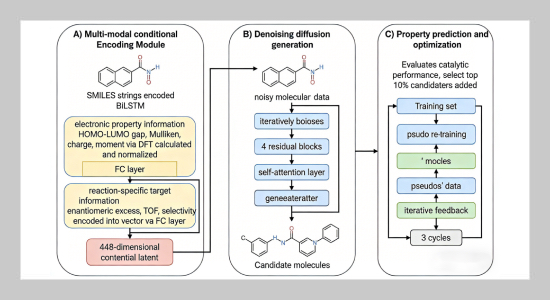
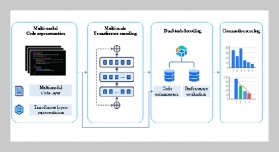
The design of environmentally friendly organic reaction catalysts with high activity and selectivity remains a core challenge in green chemistry, as traditional trial-and-error methods suffer from low efficiency and limited chemical space exploration. Conditional diffusion models (CDMs), emerging as powerful generative AI tools, offer unprecedented capabilities in molecular design by leveraging conditional constraints to guide targeted generation. Herein, we propose a CDM-based framework for the rational design and performance optimization of green organic catalysts, focusing on two representative reactions: asymmetric Henry reaction and CO2 cycloaddition. First, a multi-modal conditional module integrating molecular descriptors (e.g., HOMO-LUMO gap, charge distribution) and reaction-specific requirements (e.g., enantioselectivity, catalytic activity) is constructed to embed conditional information into the diffusion process. Second, a hybrid loss function combining denoising score matching (DSM) and property prediction loss is developed to enhance the alignment between generated molecules and target properties. Finally, a high-throughput virtual screening (HTVS) pipeline integrated with quantum mechanical (QM) calculations is established to validate the catalytic performance of generated candidates. Experimental results demonstrate that the proposed CDM framework outperforms state-of-the-art generative models in terms of generation diversity ( 92.3% unique molecules), property alignment ( 87.1% of generated molecules meet target property thresholds), and catalytic activity ( 12 out of 20 synthesized candidates exhibit catalytic efficiency higher than commercial catalysts). Notably, the best candidate for CO2 cycloaddition achieves a turnover frequency (TOF) of 420h−1 and a selectivity of 99.5% under mild conditions ( 30◦C,1 atmCO2 ), while the optimal asymmetric Henry catalyst delivers an enantiomeric excess (ee) of 96.2%. This work provides a paradigm for the rapid development of environmentally friendly catalysts via AI-driven generative design, bridging the gap between computational modeling and experimental catalysis.
[1] M.Melikoglu, (2025) “Microwave-assisted extraction: Recent advances in optimization, synergistic approaches, and applications for green chemistry" Sustainable Chemistry for Climate Action: 100122. DOI: 10.1016/j.scca.2025.100122.
[2] A. Hussain, I. Ghaffar, S. Sattar, M. Muneeb, A. Hasan,andB.Deepanraj,(2025)“Eco-friendly catalysts revolutionizing energy and environmental applications: An overview" Topics in Catalysis 68(5): 487–509. DOI: 10.1007/s11244-024-01976-y.
[4] T. Xia, Z. Yu, X. Wu, J. Qu, and Y. Chen, (2025) “Catalytic Reductive Addition of Imine for Chiral Amine Synthesis: Recent Advances and Future Perspectives" Chem Cat Chem 17(1): e202401407. DOI: 10.1002/cctc. 202401407.
[5] R. Wang, Y.-J. Liang, K.-J. Bian, J. Xu, S.-Y. Zhou, R.-X. Jin, W. Guan, and X.-S. Wang, (2025) “Bioinspired Cop per/Amine Cooperative Catalysis Enables Asymmetric Radical Azidation" Journal of the American Chemical Society 147(8): 6644–6653. DOI: 10.1021/jacs.4c15840.
[6] S. Yin, H. Li, A. A. Laghari, T. R. Gadekallu, G. A. Sampedro, and A. Almadhor, (2024) “An anomaly detection model based on deep auto-encoder and capsule graph convolution via sparrow search algorithm in 6G In ternet of Everything" IEEE Internet of Things Journal 11(18): 29402–29411. DOI: 10.1109/JIOT.2024.3353337.
[7] Y. Jiang and S. Yin, (2023) “Heterogenous-view occluded expression data recognition based on cycle-consistent adversarial network and K-SVD dictionary learning under intelligent cooperative robot environment" Computer Science and Information Systems 20(4): 1869–1883. DOI: 10.2298/CSIS221228034J.
[8] Z. Chang, G. A. Koulieris, H. J. Chang, and H. P. Shum, (2026) “On the design fundamentals of diffusion models: A survey" Pattern Recognition 169: 111934. DOI: 10.1016/j.patcog.2025.111934.
[9] Z. Zhou, S. Shao, L. Bai, S. Zhang, Z. Xu, B. Han, and Z. Xie. “Golden noise for diffusion models: A learning framework”. In: Proceedings of the IEEE/CVF Inter national Conference on Computer Vision. 2025, 17688 17697. DOI: 10.1201/9781351051507-10.
[10] F. Shen, H. Ye, S. Liu, J. Zhang, C. Wang, X. Han, and Y. Wei. “Boosting consistency in story visualization with rich-contextual conditional diffusion models”. In: Proceedings of the AAAI Conference on Artificial In telligence. 39. 7. 2025, 6785–6794. DOI: 10.1609/aaai.v39i7.32728.
[11] Y. Zhang, X. Xiao, Y. Huang, J. Si, S. Liang, Q. Xu, H. Zhang, L. Ma, C. Yang, X. Zhang, et al., (2025) “Crystal structure and Mulliken charge analysis of Gd3+ doped bismuth silicate" Materialia 39: 102323. DOI: 10.1016/j.mtla.2024.102323.
[12] Q. Wang, X. Xiao, Z. Miao, X. Zhang, D. Yang, B. Jiang, and M. Liu, (2025) “Prediction of Protein B-factor Profiles based on Bidirectional Long Short-Term Memory Network" IEEE Transactions on Computational Biology and Bioinformatics: DOI: 10.1109/TCBBIO.2025.3564284.
[13] C. Liu, J. Zhang, S. Wang, W. Fan, and Q. Li, (2025) “Score-based generative diffusion models for social recommendations" IEEE Transactions on Knowledge and Data Engineering: DOI: 10.1109/TKDE.2025.3600103.
[14] K. Elamvazhuthi, D. Gadginmath, and F. Pasqualetti, (2025) “Score Matching Diffusion Based Feedback Control and Planning of Nonlinear Systems" arXiv preprint arXiv:2504.09836: DOI: 10.48550/arXiv.2504.09836.
[15] Q. Pu, Q. Zhang, Z. Wang, and Y. Chen. “Research on the Design and Iterative Optimization of Immersive Virtual Reality Learning Scenarios”. In: 2025 7th International Conference on Computer Science and Technologies in Education (CSTE). IEEE. 2025, 671–675. DOI: 10.1109/CSTE64638.2025.11092035.
[16] P. T. Merz and M. R. Shirts, (2018) “Testing for physical validity in molecular simulations" PloS one 13(9): e0202764. DOI: 10.1371/journal.pone.0202764.
[17] H. Yuan, Q. Zhou, and Y. Zhang, (2026) “Improving fibre alignment during electrospinning" Electrospunnanofibers: 91–113. DOI: 10.1016/B978-0-443-21519-3.00025-X.
[18] P. Baconnier, O. Dauchot, V. Démery, G. Düring, S. Henkes, C. Huepe, and A. Shee, (2025) “Self-aligning polar active matter" Reviews of Modern Physics 97(1): 015007. DOI: 10.1103/RevModPhys.97.015007.
We use cookies on this website to personalize content to improve your user experience and analyze our traffic. By using this site you agree to its use of cookies.